

Net Metering Solar System in Bangladesh
A net metering solar system in Bangladesh is a grid-connected rooftop solar plant that powers your building first and exports any surplus to the grid through a bi-directional meter. Under the government's Net Metering Guideline, exported units are set off against the units you import, so your bill is based on the net amount.
A net metering solar system in Bangladesh lets a home, office, school or factory produce its own electricity on the roof and still rely on the grid at night or on cloudy days. Whenever the panels generate more than the building needs, the surplus is exported and recorded, and it reduces the units you are billed for. TOTO POWER Engineering, an engineering firm operating since 2011 with offices in Dhaka and Chittagong, designs and installs net metering systems and handles the technical side of the utility application.
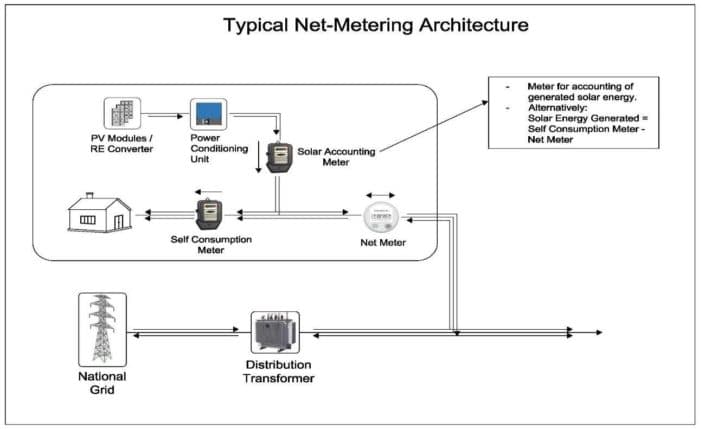
How does a net metering solar system work?
The solar panels produce direct current, which a grid-tied inverter converts into alternating current at the same voltage and frequency as the grid. The inverter feeds the building's main distribution board, so your loads use solar electricity first. At the point where the building connects to the utility, the old import-only meter is replaced by a bi-directional (net) meter that records energy in both directions.
- When solar output is lower than demand, the building draws the shortfall from the grid and the meter records import.
- When solar output is higher than demand, the surplus flows out to the grid and the meter records export.
- At billing time, exported units are set off against imported units. If export is larger than import in a billing period, the remaining credit is handled under the carry-forward and settlement rules in the guideline.
Many installations also include a separate solar generation meter, so the owner and the utility can see how much energy the plant produces in total.
What does the Net Metering Guideline say?
Net metering in Bangladesh is governed by the Net Metering Guideline issued in 2018 under the Power Division, with the Sustainable and Renewable Energy Development Authority (SREDA) responsible for promoting renewable energy. The guideline sets out who may apply, the technical conditions for connection, how imported and exported energy are measured and billed, and the role of the distribution utility. Utilities apply the guideline through their own procedures and forms, and the rules have been revised over time, so the details that apply to your connection should always be confirmed with your utility at the time of application.
Who is eligible, and how large can the system be?
In general terms, the applicant must be an existing, regular customer of the distribution utility, must own the solar system or have legal permission to install it on the premises, and must use a renewable energy source. Arrears on the electricity account can hold up an application.
System size is limited in three ways. The guideline links the permitted capacity to your sanctioned load. The utility checks that the local distribution transformer and feeder can accept the export. And the roof sets a physical limit, because only shade-free, structurally sound area can carry panels. We check all three before proposing a size, so the system you are quoted is one the utility is likely to approve.
How do you apply for net metering?
The application is made to your distribution utility, such as DESCO, DPDC, BREB through its Palli Bidyut Samities, or the other distribution companies in your area. Procedures differ slightly between utilities, but the general sequence is:
- Application. The customer submits the net metering application with the customer account details, ownership or permission documents and the proposed system capacity.
- Technical documents. We prepare the single line diagram, equipment specifications and layout drawings that the utility asks for.
- Utility review. The utility checks eligibility and network capacity and may inspect the site.
- Installation. Once the proposal is accepted, the system is installed to the approved design.
- Inspection and meter change. The utility inspects the installation and protection settings, then installs or approves the bi-directional meter.
- Agreement and commissioning. A net metering agreement is signed and the system is energised for export.
How is a net metering system designed?
Good design starts with your electricity bills and load profile, not with the size of the roof. We look at monthly consumption, daytime and night-time demand and any planned load growth, then design an array that makes the best use of export credit without exceeding the permitted capacity.
- Roof and structure. The roof is checked for shading, orientation, access, waterproofing and its ability to carry the array and wind load. For older or lightweight roofs, our structural design team checks the slab or steel frame and designs the mounting structure.
- Modules and inverter. Panels and a grid-tied inverter are chosen to suit the array size, string voltages and the utility's connection requirements, including anti-islanding protection.
- Protection and earthing. DC and AC isolators, surge protection devices, fuses, breakers and a dedicated earthing system are specified. Where the roof is exposed, the array is integrated with a lightning protection system designed to IEC 62305.
- Metering and monitoring. The design shows the net meter, any solar generation meter, and inverter monitoring so you can track output.
How is the system installed?
- Site survey, load analysis and roof assessment
- System design, drawings and the utility application package
- Supply and installation of the mounting structure and solar modules
- Installation of the inverter, DC and AC cabling, protection and earthing
- Testing: insulation resistance, polarity, earth resistance and inverter settings
- Utility inspection, net meter installation and commissioning
- Handover with operation guidance and documentation
What you receive
- A site survey and load analysis report
- System design with layout drawings and a single line diagram
- Technical documents for the net metering application
- Supply, installation and testing of the complete system
- Coordination with the utility for inspection and meter installation
- Commissioning records, equipment manuals and warranty documents
- A maintenance schedule for the system
Net metering vs on-grid self-consumption vs hybrid
Net metering is one of three common ways to connect rooftop solar. The right choice depends on when you use electricity and whether you need backup power.
| Feature | Net metering | On-grid self-consumption | Hybrid with batteries |
|---|---|---|---|
| Surplus energy | Exported and credited against imports | Not exported; output is limited to the load | Stored in batteries, then exported or limited |
| Meter | Bi-directional net meter from the utility | Existing meter, with export prevented | Depends on whether export is approved |
| Utility approval | Net metering application and agreement | Simpler; confirm requirements with the utility | Required if connected for export |
| Works in a grid outage | No | No | Yes, for backed-up loads |
| Best suited to | Homes, offices, schools, buildings with idle days | Factories with high, steady daytime load | Sites that need backup during load-shedding |
If you are not sure export makes sense for you, see our on-grid solar system and rooftop solar system pages for the alternatives.
How is a net metering system maintained?
Grid-tied systems have few moving parts, but dust, bird droppings and air pollution reduce output quickly in Bangladesh, especially in the dry season. A sensible plan includes regular module cleaning with clean water and soft equipment, monthly checks of inverter output and alarms, periodic inspection of cables, connectors and mounting bolts, an annual thermal scan of the DC and AC connections, and an earth resistance test. Compare the generation meter with expected output: a sudden fall usually points to a fault, shading or dirt.
What does a net metering solar system cost in Bangladesh?
We do not publish a standard price, because the cost depends on the project. The main cost factors are the system capacity, the type and quality of modules and inverter, the mounting structure (flat concrete roof, metal sheet roof or elevated frame), cable lengths from roof to switchboard, protection and lightning protection requirements, any roof strengthening, utility application and metering costs, and the site location. After a survey we send a written quotation, and we can show how the expected generation compares with your current bills.
How to choose a net metering solar company in Bangladesh
When you compare net metering solar companies, look beyond the price per kilowatt. Ask whether the company will check your roof structure, whether it prepares the single line diagram and utility documents itself, which inverter protections it provides, how it earths and protects the array against lightning, and what maintenance and warranty support is included. Ask to see a completed installation and its monitoring data.
TOTO POWER Engineering combines electrical, structural and testing services in one firm, so the same team can design the system, check the roof, prepare the electrical drawings and test the installation before the utility inspects it. That reduces the risk of a rejected application or a system that underperforms. If you are comparing net metering solar system offers, send us your recent electricity bills and roof details and we will advise whether net metering suits your building.