

Detailed Engineering Assessment (DEA) in Bangladesh
A Detailed Engineering Assessment (DEA) in Bangladesh is an in-depth structural investigation of an existing building. Engineers survey the as-built structure, test the concrete, reinforcement and soil, model the building to BNBC 2020, and report whether it can safely carry its loads, with a floor load plan and strengthening design where it cannot.
A Detailed Engineering Assessment (DEA) in Bangladesh is the step that turns a structural concern into a clear engineering answer. An initial inspection can tell you that a column is cracked or a floor looks overloaded; a DEA tells you how strong the concrete really is, what reinforcement is inside the members, what the foundation can carry, and what must be done about it. TOTO POWER Engineering is an engineering consultancy operating since 2011 and enlisted with the Department of Inspection for Factories and Establishments (DIFE). Our structural engineers carry out DEAs for garment and other industrial factories, commercial buildings and residential blocks from our offices in Dhaka and Chittagong.
What is a Detailed Engineering Assessment?
A DEA is a structural investigation of an existing building that is based on measured information rather than appearance. Engineers first establish exactly what was built, because in many older buildings the approved drawings are missing or do not match the structure. They then test the materials in place, check the foundation and ground, and build a structural model that is analysed for the loads the building carries today and any loads the owner plans to add.
The outcome is a set of decisions the owner can act on: which floors are safe for their current use, what each floor may carry, whether extra storeys are possible, and which members need strengthening. Because it is evidence-based, a DEA is also the document that inspectors and buyers rely on when they decide whether a building can stay in use.
When is a DEA required?
A DEA is not a routine annual check. It is normally required in one of these situations:
- After an initial assessment finding. If an initial assessment reports structural cracking, signs of overloading, unexplained deflection, poor-quality concrete or missing structural drawings, the usual recommendation is a DEA.
- Change of use. Converting an office or residential floor into production, storage or a warehouse can multiply the floor load. The structure must be checked for the new use before the change is made.
- Extra floors. Before a vertical extension, the columns and foundation must be proven to carry the added storeys, or a strengthening scheme designed.
- Buyer and compliance programmes. Export buyers and industry safety programmes for RMG factories, such as those that followed the Accord and today's RMG Sustainability Council (RSC), commonly require a DEA when a structural concern is raised. The exact requirement is set by the programme, so we work from its written findings.
- Purchase, lease or finance. Owners, tenants and lenders sometimes ask for a DEA before buying or leasing an existing building of uncertain history.
What does a DEA include?
The scope is fixed after a first visit and a review of whatever drawings exist. A complete Detailed Engineering Assessment usually covers the following work.
As-built drawing survey
If reliable drawings do not exist, our team measures every structural member on every floor: column, beam and slab sizes, grid lines, floor heights, openings, water tanks and roof structures. The survey is turned into as-built architectural and structural drawings in plan, section and elevation. Where drawings do exist, we check a sample of members to confirm that the building matches them and record any differences.
Rebar scanning
Rebar scanning with a cover meter or scanner locates the reinforcement inside columns, beams and slabs without breaking the concrete. It shows bar spacing, approximate diameter and concrete cover, so the model uses the reinforcement that is really there. Where needed, a small area of cover is removed to confirm the bar size directly.
Rebound hammer and UPV tests
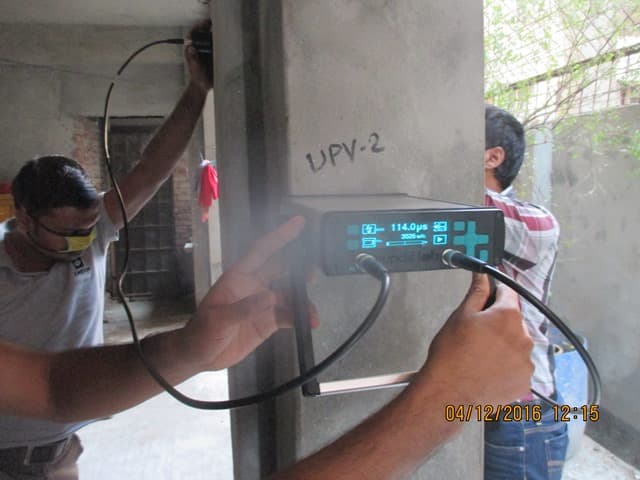
The rebound hammer test (ASTM C805) measures surface hardness, and the UPV test (ASTM C597) measures how fast an ultrasonic pulse travels through the concrete. Together they give a quick picture of concrete uniformity across many members and help us choose where to drill cores. Neither test gives a design strength on its own.
Concrete core tests
A core test (ASTM C42) removes a cylinder of concrete from selected members for compression testing in a laboratory. Core results are the most direct measure of in-place strength, and they are used to calibrate the non-destructive results. Core locations are chosen to avoid reinforcement, and the holes are repaired with a suitable non-shrink material afterwards.
Soil investigation and foundation check
Foundation details are often the least documented part of an existing building. Where they are unknown, we excavate beside selected footings to measure them, and arrange a soil test with boreholes to confirm the bearing capacity of the ground. For piled buildings, available pile records and integrity tests are reviewed.
Structural analysis and modelling to BNBC 2020
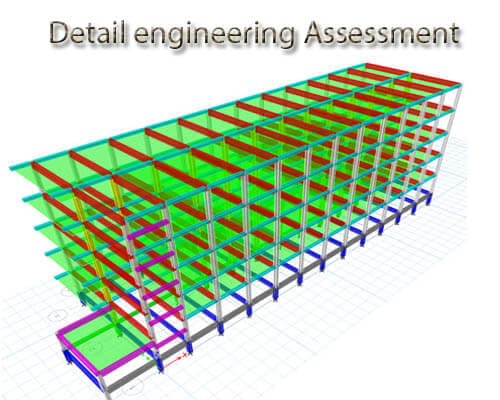
Using the as-built geometry and the measured material properties, our engineers build a three-dimensional computer model of the building and analyse it for dead, live, wind and seismic loads under the Bangladesh National Building Code (BNBC) 2020. Each column, beam, slab and footing is checked for strength and serviceability, and the model is used to test what-if cases such as heavier machinery or an added floor.
Load plan
Every DEA ends with a floor load plan that shows the permitted load on each area of each floor, in a format that can be displayed on site so that supervisors do not overload the structure with stock, machines or water tanks.
How is a Detailed Engineering Assessment carried out?
- Document review and site visit. We study existing drawings, earlier assessment reports and the findings that triggered the DEA, then walk the building with your team.
- Investigation plan. We agree the test locations, the number of cores and boreholes, access arrangements and a programme that limits disruption to production.
- As-built survey. The structure is measured and as-built drawings are prepared or verified.
- Field testing. Rebar scanning, rebound hammer, UPV and core sampling are carried out, and foundation excavation or soil boreholes where needed.
- Laboratory testing. Cores and soil samples are tested and the results are checked against the field data.
- Structural analysis. The building is modelled and checked to BNBC 2020 for current and proposed loads.
- Recommendations and design. We set loading limits, prepare the floor load plan and design strengthening or retrofit work for any inadequate members.
- Report and follow-up. The DEA report is issued, findings are explained to the owner, and remediation items are carried into the corrective action plan (CAP).
What you receive
- Verified as-built architectural and structural drawings
- Field and laboratory test results with test locations marked on plans
- A DEA report explaining the model, loads, assumptions and the adequacy of each structural member
- Recommendations on permitted use, loading and any vertical extension
- A floor load plan ready to display on site
- A retrofit and strengthening design with working drawings and notes, where members are found inadequate
- Remediation items formatted for your corrective action plan (CAP)
Initial assessment and DEA compared
| Aspect | Initial assessment | Detailed Engineering Assessment |
|---|---|---|
| Purpose | Identify visible risks and decide what needs investigating | Quantify real capacity and specify loading limits and repairs |
| Method | Visual inspection, document review, observation of loading | As-built survey, NDT, core and soil tests, structural analysis |
| Testing | Little or none | Rebar scanning, rebound hammer, UPV, cores, boreholes |
| Main output | Risk-ranked findings and a recommendation | DEA report, load plan, retrofit design, CAP items |
Why use a DIFE enlisted firm in Bangladesh for DEA?
The Department of Inspection for Factories and Establishments (DIFE) oversees workplace safety under the Bangladesh Labour Act 2006 and the Bangladesh Labour Rules 2015. Choosing a DIFE enlisted company in Bangladesh means your assessor is already recognised by the authority that inspects your factory, which helps when your DEA report is reviewed. If you are unsure what the listing involves, read our article on what DIFE enlistment means.
Enlistment is a starting point, not a guarantee of quality. When you compare firms, ask to see a sample DEA report, check that the structural engineers who sign it are qualified and experienced in existing buildings, and confirm that tests are done to recognised standards. TOTO POWER Engineering brings structural, electrical and fire safety assessment together, so findings from our structural safety assessment work flow straight into the DEA without being re-learned by a new team.
How long does a DEA take?
No two buildings are the same, so we do not quote a standard duration. The programme depends on the floor area and number of storeys, whether as-built drawings must be produced from scratch, how many cores and boreholes are needed, how easily we can reach members in a working factory, laboratory turnaround, and how quickly the owner can provide documents and access. We confirm a realistic schedule after the first visit.
What does a DEA cost in Bangladesh?
The fee is built from the work required. The main cost factors are the size and height of the building, the number of test locations, cores and boreholes, whether a full as-built survey is needed, the complexity of the structure (for example, mixed RCC and steel or several extensions built at different times), whether a retrofit design is required, and the site location. After the site visit we send a written quotation with the scope listed item by item, so you know what is included before you commit.
Which standards apply?
Structural adequacy is checked against BNBC 2020. Field and laboratory tests follow recognised methods such as ASTM C805 for the rebound hammer, ASTM C597 for UPV and ASTM C42 for drilled cores. For factories, the wider legal framework is the Bangladesh Labour Act 2006 and Labour Rules 2015, enforced by DIFE. Where a buyer programme has its own technical guidance, we follow it alongside the national code.