

Rebound Hammer Test in Bangladesh
A rebound hammer test in Bangladesh is a quick, non-destructive check of concrete surface hardness. A spring-driven mass strikes the concrete and the rebound is read as a number. Higher numbers indicate harder, usually stronger concrete. Engineers use it to compare members, find weak areas and, after calibration against cores, estimate strength.
The rebound hammer test is one of the fastest ways to check concrete in a building without damaging it. Poor materials, too much water in the mix and poor curing can all leave concrete weaker than the design assumed, and you cannot break open columns to find out. TOTO POWER Engineering, an engineering consultancy working in Bangladesh since 2011 and enlisted with the Department of Inspection for Factories and Establishments (DIFE), carries out rebound hammer testing for factories, commercial buildings and apartment blocks from our Dhaka and Chittagong offices.
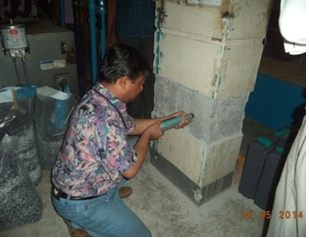
What is a rebound hammer test?
The rebound hammer, often called a Schmidt hammer, is a hand-held instrument that measures the surface hardness of concrete. Inside it, a spring-loaded mass strikes a plunger pressed against the concrete and bounces back. The distance it rebounds is shown as the rebound number. A hard, dense surface returns more energy, so the mass rebounds further and the number is higher; a soft or weak surface absorbs more energy and gives a lower number.
Because hardness and compressive strength are related, the rebound number can be used to estimate strength. That relationship is not fixed: it changes with the cement, aggregate, age, moisture and surface condition. For this reason, the test is best used to compare concrete within one building and to choose where to verify strength by other means.
Hammer test in Bangladesh: when is it needed?
A hammer test in Bangladesh is most often carried out as part of a structural investigation of an existing building. Typical situations include:
- Detail Engineering Assessment. A Detail Engineering Assessment (DEA) of an RMG or industrial building needs concrete strength data for the structural model. The hammer test screens many members quickly.
- Older buildings. Buildings without test records or reliable drawings, especially before adding floors or changing use.
- Signs of distress. Cracking, spalling or exposed corroded bars, where the engineer needs to know whether the concrete itself is weak.
- After fire damage. Comparing fire-affected areas with undamaged concrete in the same building.
- Quality checks on new work. When cylinder or cube results are low or missing, or when the owner wants an independent check of a contractor's concrete.
The test can be used on columns, beams, slabs, walls and exposed parts of foundations. Columns are usually given priority because they carry the building's load and a weak column is the most serious finding.
How is the rebound hammer test done?
The procedure follows ASTM C805, the standard test method for the rebound number of hardened concrete. In outline:
- Plan the test locations. The engineer selects members on each floor so that the results represent the building, with more locations on critical columns.
- Check the hammer. The hammer is checked on its test anvil before use so that a worn or faulty instrument does not give false readings.
- Prepare the surface. Plaster and finishes are removed over a small area, and the concrete is ground smooth with an abrasive stone. Honeycombed, scaled or highly porous patches are avoided, and the location is kept clear of bars near the surface, which a rebar scan can locate.
- Take the readings. At least ten readings are taken at each location, with the impact points spaced apart rather than repeated on the same spot. The hammer is held firmly and perpendicular to the surface.
- Allow for orientation. Readings depend on the direction of impact, because gravity acts differently when the hammer points upwards at a slab soffit, sideways at a column or downwards at a floor. The direction is recorded, and readings are corrected or interpreted using the relationship for that orientation.
- Screen and average. Readings that differ markedly from the rest of the set are discarded as the standard sets out, and the remaining readings are averaged to give the rebound number for that location.
- Interpret and report. Results are compared across the building, calibrated against cores where available, and reported with the engineer's conclusions.
How are rebound hammer results interpreted?
The first use of the results is comparison. Rebound numbers that are consistent across a floor suggest uniform concrete; a member that reads clearly lower than its neighbours stands out for further investigation. This is valuable even before any strength is calculated.
To turn rebound numbers into strength estimates, the readings need a correlation. Generic charts supplied with hammers are based on particular concretes and test conditions, and they can misjudge the strength of a specific building. The reliable approach is to take a core test at some of the hammer locations, measure the actual strength of those cores in a laboratory, and use the pairs of results to calibrate the hammer readings for that building. The calibrated relationship is then applied to the remaining hammer locations, so a small number of cores supports a much larger number of strength estimates.
What are the limitations of the rebound hammer test?
- It tests the surface only. The hammer responds to the outer layer of concrete. It says little about the core of a thick member or about internal voids.
- Carbonation. In older concrete, carbonation hardens the surface layer, which can raise rebound numbers and make the concrete appear stronger than it is.
- Surface moisture. A wet surface usually gives lower readings than a dry one, so the moisture condition at the time of testing is recorded.
- Surface texture and finishes. Rough, trowelled or plastered surfaces give different readings from smooth formed concrete, which is why preparation matters.
- Local features. A hard aggregate particle or a void just below the plunger affects a single reading, which is why many readings are averaged.
Rebound hammer combined with UPV and core tests
Because the hammer measures the surface and the UPV test measures how fast an ultrasonic pulse travels through the full depth of the member, the two methods complement each other. Carbonation may raise the rebound number, for example, but it does not affect UPV in the same way. Using both, and calibrating them against cores, gives a far more reliable picture of concrete quality than any single non-destructive test.
| Test | What it measures | Damage | Main use |
|---|---|---|---|
| Rebound hammer (ASTM C805) | Surface hardness (rebound number) | None | Fast screening and comparison of many members |
| UPV (ASTM C597) | Pulse velocity through the concrete | None | Uniformity, internal cracks and voids |
| Core test (ASTM C42) | Compressive strength of a drilled core | Small hole, repaired after coring | Measured strength and calibration of NDT results |
What you receive
- A layout of test locations on each floor plan
- Rebound numbers for each location, with hammer orientation and surface condition
- Estimated concrete strength, calibrated against cores where cores were taken
- Identification of weak or non-uniform members
- Photographs of test locations
- Engineer's conclusions and recommendations, such as further cores or strengthening
What does a rebound hammer test cost in Bangladesh?
We do not quote a fixed price without seeing the job. The main cost factors are the number of test locations and floors, access to the members, the amount of plaster removal and making good, whether UPV and cores are included for calibration, travel to the site and the level of reporting required. A hammer test is usually far cheaper per location than coring, which is why it is used to cover the building and cores are kept for calibration and critical members.
Why choose TOTO POWER Engineering?
A rebound hammer is easy to buy; reliable results are not. Our engineers plan the test locations around the structure, prepare the surface properly, record the conditions that affect readings and interpret the results as structural engineers, not just technicians. Because we also carry out rebar scanning, UPV, core tests and structural assessments, the hammer test fits into a complete investigation. See all our testing and inspection services.