

Rooftop Solar System in Bangladesh
A rooftop solar system in Bangladesh is a set of photovoltaic panels mounted on the roof of a home, office or factory, with an inverter that turns their DC output into usable AC power. The electricity runs the building's own loads first and, under net metering, any surplus can be exported to the grid.
TOTO POWER Engineering designs, supplies and installs rooftop solar systems in Bangladesh for factories, commercial buildings and homes. We have worked as an engineering consultancy since 2011, so our solar work is backed by electrical, structural and safety engineering in the same firm. That matters on a roof: the panels must produce power safely, the structure must carry them through cyclone-season winds, and the roof must stay watertight for decades.
Cities and industrial areas in Bangladesh have large areas of flat or sloping roof that sit unused. Putting solar panels there generates electricity where it is consumed, without taking up land that is needed for buildings or farming, and with very little impact on the surroundings.
What is a rooftop solar system?
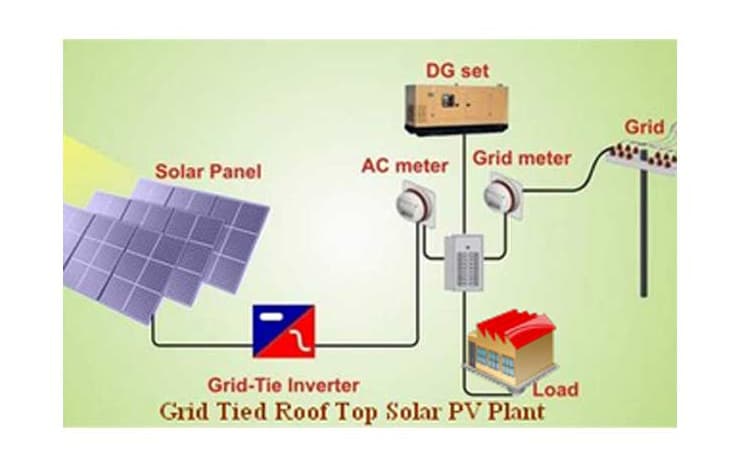
A rooftop solar system is a photovoltaic (PV) installation mounted on the roof of a building, or integrated into its façade, that converts sunlight into electricity. Solar modules produce direct current (DC). An inverter converts this to alternating current (AC) at the voltage and frequency of the building's supply, so it can run lights, fans, machines, air conditioners and pumps. Power is used inside the building first; depending on the system type, any surplus is either stored in batteries or exported to the grid.
What types of rooftop solar system are there?
On-grid rooftop solar
An on-grid system connects directly to the building's grid supply and has no batteries. It reduces the energy you buy from the utility during daylight hours and, with an approved connection, can export surplus energy. It is the simplest and lowest-maintenance option, but for safety it shuts down during a grid outage. Read more on our on-grid solar system page.
Off-grid rooftop solar
An off-grid system works independently of the grid. Batteries store energy for the night and cloudy days, and a charge controller and inverter manage the flow. It suits sites with no grid connection or a very weak supply, but the battery bank must be sized carefully and replaced during the system's life.
Hybrid rooftop solar
A hybrid system is grid-connected but also has batteries. It uses solar first, charges the batteries, draws on the grid when needed and keeps essential loads running during outages. It is a common choice where load-shedding interrupts work or where critical equipment must stay on.
Rooftop solar options compared
| Type | Batteries | Works in a grid outage | Best suited to |
|---|---|---|---|
| On-grid | No | No | Factories and offices with a reliable grid and high daytime load |
| Off-grid | Yes | Yes (no grid needed) | Remote sites without a grid connection |
| Hybrid | Yes | Yes, for selected loads | Homes and businesses with frequent outages or critical loads |
How does net metering work for rooftop solar?
Bangladesh's Net Metering Guideline 2018, introduced through SREDA and the power sector authorities, lets consumers with grid-connected rooftop solar export surplus electricity to their distribution utility. A bidirectional meter records both imported and exported units, and the exported units are set off against the bill. The connection must be approved by the utility before export. We explain the process in detail on our net metering solar system page.
Which components make up a rooftop solar system?
- Solar PV modules, the panels that convert sunlight into DC electricity.
- Inverter (string, central or hybrid), which converts DC to AC and synchronises with the grid.
- Mounting structure of galvanised steel or aluminium, designed for the roof type and wind load.
- DC and AC cabling with UV-resistant insulation, combiner boxes, isolators, fuses and surge protection devices.
- Earthing and lightning protection to protect the array and the building.
- Batteries and charge control for off-grid and hybrid systems.
- Monitoring so you can see generation and spot faults early.
- Bidirectional meter for net-metered systems, installed by the utility.
How are panels mounted on RCC and metal sheet roofs?
RCC (flat concrete) roofs are common on homes, offices and multi-storey factories. Panels sit on tilted frames, either anchored into the slab or held down with ballast blocks. The tilt is chosen for good year-round output and to let rain wash dust off. Anchors must be sealed so they do not cause leaks, and frames are raised enough to allow cleaning and drainage beneath.
Metal sheet roofs are typical of steel-structure factories and warehouses. Panels are usually mounted flush with the roof slope on rails fixed with sheet clamps or through-bolts into the purlins, using sealed fixings. This keeps the weight and wind load low, but the roof sheet, purlins and frame must be checked, as older sheets may need replacing before installation.
In both cases we recommend a roof structural check before installation. Our structural design team can confirm that the roof can carry the panels, frames and wind uplift, and design strengthening if it cannot.
How is a rooftop solar system sized?
Sizing balances three things: how much electricity you use, when you use it, and how much roof you have. We review twelve months of electricity bills where available, measure or estimate the daytime load profile, and survey the unshaded roof area. For an on-grid system the aim is usually to supply as much daytime load as possible without wasting energy. For off-grid and hybrid systems, the battery bank is sized for the loads you need at night and during outages. Seasonal variation matters: output is lower in the cloudier monsoon months, so the design accounts for the whole year, not only the dry season.
How is a rooftop solar system installed?
- Site survey. We inspect the roof, shading, orientation, access, electrical room and existing supply.
- Structural check. The roof's capacity is confirmed, and strengthening is designed if needed.
- Design. We prepare the array layout, string design, single line diagram, cable sizing and protection scheme.
- Approvals. For net-metered systems, we prepare the documents for the utility application.
- Installation. Mounting structures, panels, inverters, cabling, earthing and protection devices are installed with roof safety precautions.
- Testing and commissioning. We test insulation resistance, polarity, string voltages and earthing, then commission the inverter and monitoring.
- Handover. You receive documents and training on safe operation and basic checks.
How should a rooftop solar system be maintained?
Rooftop solar has no moving parts, but it does need care. Dust and bird droppings reduce output, so panels should be cleaned regularly with clean water and a soft brush, never with abrasive materials or high-pressure jets. Before the monsoon, check that fixings are tight, drains under the array are clear and cable entries are sealed. After storms, look for debris, loose clamps or damaged cables. Each year, an electrician should inspect connections, isolators, surge protection and earthing, and review inverter logs for faults. For hybrid and off-grid systems, battery condition should also be checked.
What you receive
- Site survey report with shading and roof assessment
- System design: array layout, single line diagram and cable schedule
- Structural confirmation for the roof and mounting
- Net metering application support for grid-connected systems
- Installed, tested and commissioned system with test records
- Equipment data sheets, warranty documents and as-built drawings
- Operation and maintenance guidance, with optional maintenance visits
What does a rooftop solar system cost in Bangladesh?
The cost depends on the system capacity, the type (on-grid, off-grid or hybrid), battery capacity, the specification of modules and inverters, the roof type and any strengthening needed, the cable distance to the electrical room, and monitoring requirements. Battery systems cost more up front and over their life. Because these factors vary so much, we give a written quotation after the site survey rather than a fixed price per kilowatt.
Which standards apply?
The electrical installation follows good practice for low-voltage installations such as IEC 60364, with lightning protection designed with reference to IEC 62305. Grid-connected systems must meet the distribution utility's requirements under the Net Metering Guideline 2018. The roof structure is checked against BNBC 2020 loads, including wind. For factories, the installation also needs to be safe under the electrical requirements that DIFE and buyer audits review.
Why choose TOTO POWER Engineering?
If you are comparing solar companies in Bangladesh, look for a firm that checks the roof as carefully as it chooses the panels. We combine solar design with in-house structural, electrical and lightning protection expertise, and we have completed more than 500 engineering projects across industrial, commercial and residential buildings. See all our solar options on the solar systems page.