

Rebar Scanning in Bangladesh
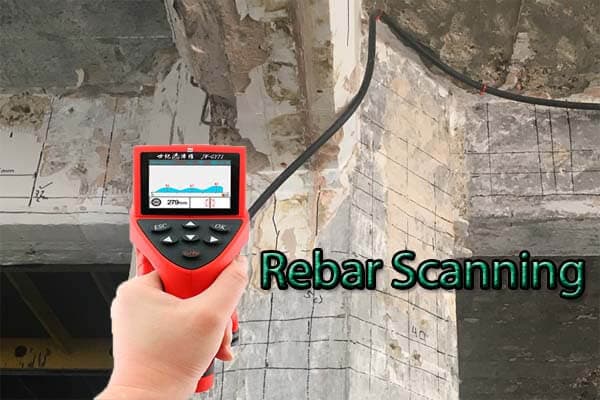
Rebar scanning in Bangladesh is a non-destructive test that finds the steel reinforcement inside a concrete slab, beam, column or wall from the surface. An engineer moves a scanner across the concrete to record where each bar is, how far apart the bars are, how deep the concrete cover is and roughly what diameter they are.
Rebar scanning answers a simple question that matters before almost any work on existing concrete: where is the steel? Whether you plan to drill a core, fix an anchor for new machinery, cut an opening in a slab or check whether a contractor followed the drawings, the scan tells you what is inside the member without breaking it. TOTO POWER Engineering has worked as an engineering consultancy in Bangladesh since 2011 and is enlisted with the Department of Inspection for Factories and Establishments (DIFE). Our engineers carry out rebar scanning for factories, commercial buildings and residential projects from our Dhaka and Chittagong offices.
What is rebar scanning?
Reinforced concrete depends on steel bars placed in the right position, at the right spacing and with enough concrete around them. Concrete carries compression well but is weak in tension, so the bars carry the tension. The concrete cover, the layer between the bar and the surface, protects the steel from corrosion and fire. If bars are missing, too widely spaced or too close to the surface, the member may not carry its design load or may deteriorate early.
Rebar scanning is the non-destructive method of finding those bars from the surface. The scanner is moved across the concrete in straight lines or over a marked grid. Each time it passes over a bar, it records a response, and the engineer marks the bar position on the concrete. From these marks and readings, the engineer works out spacing, cover and an estimate of bar size, and compares them with the structural drawings.
Which methods are used: electromagnetic scanners or GPR?
Two families of instrument are commonly used to locate reinforcement. They answer slightly different questions, and it helps to know which one suits your job before the site visit.
Electromagnetic cover meters and scanners
A cover meter, or electromagnetic rebar scanner, creates a magnetic field and measures how it is disturbed by nearby steel. It responds only to metal, so it is not confused by moisture, voids or plastic pipes. It is the standard tool for measuring concrete cover, and it can estimate bar diameter when the cover is known. Scanners of this type can be used along single lines or, in imaging versions, over a marked area to produce a picture of the bar grid.
Ground-penetrating radar (GPR)
GPR sends radar pulses into the concrete and records the reflections from anything with different electrical properties: steel bars, post-tensioning ducts, plastic or metal conduits, voids and the back face of a slab. It generally reaches deeper than an electromagnetic scanner and can show non-metallic objects, but it does not measure bar diameter directly and its results need careful interpretation. For most questions about cover, spacing and bar position, an electromagnetic scanner is the more direct tool. If you need to locate conduits or look deeper into thick members, tell us at the enquiry stage so we can advise on the appropriate method.
What does a rebar scan detect?
- Bar position. The location of each bar, marked on the concrete surface and recorded on a sketch or drawing.
- Bar spacing. The centre-to-centre distance between main bars, and between ties or stirrups in columns and beams.
- Concrete cover. The depth from the surface to the nearest bar, which can be checked against the cover specified in the design.
- Approximate bar diameter. An estimate of bar size, which is confirmed by exposing a bar where the exact size is critical.
- Number of bars. The count of main bars on an accessible face, which is used when no reliable drawings exist.
What are the limitations of rebar scanning?
Rebar scanning is reliable when it is used within its limits, and an honest report states those limits. The main ones are:
- Congested reinforcement. Where bars are very close together, lapped or bundled, the scanner may not separate individual bars, and diameter estimates become less reliable.
- Depth. Accuracy falls as cover increases. Bars in a second or third layer are often hidden behind the first layer.
- Access and surface. Thick plaster, tiles, uneven finishes or metal fixings on the surface affect readings. Plaster thickness must be allowed for when cover is reported.
- Other metal. Steel conduits, wire mesh in plaster and embedded fixings can produce responses that look like bars.
For these reasons, scans in structural assessments are usually backed up by opening a small number of locations to measure the bar directly. The scan then extends that verified information across the rest of the building.
Rebar scanning vs ferro scanning in Bangladesh
Clients often ask whether they need rebar scanning or ferro scanning in Bangladesh. Both locate reinforcement with electromagnetic methods, and the terms are often used loosely. In practice, rebar scanning is the broader term and is often done along lines with a cover meter to answer specific questions: where is the bar, how deep is it, what is the spacing. Ferro scanning normally refers to imaging a marked area with a Ferroscan-type scanner, which produces a picture of the bar grid that can be included in a report. If you need an image of the reinforcement layout across a panel of slab or wall, see our dedicated ferro scanning service in Bangladesh. If you need bar locations marked on site before coring or drilling, or a cover survey across many members, rebar scanning is usually the quicker choice. Our engineers will recommend one or both once they know your purpose.
Who needs rebar scanning?
Before coring, drilling and anchoring
Cutting a main bar while drilling for a core test, a chemical anchor or a service opening weakens the member. Scanning first lets the drill be placed between bars. This is especially important for factory owners installing new machinery, racking or pipe supports on existing slabs.
Detail Engineering Assessment and structural checks
A Detail Engineering Assessment (DEA) of an RMG or industrial building needs the actual reinforcement in columns, beams and slabs so that the structural model reflects what was built. Rebar scanning supplies that information, alongside concrete strength from the rebound hammer test, the UPV test and cores.
Checking work against drawings
Owners and developers use rebar scanning to check that a contractor placed the number and spacing of bars shown on the structural drawings and maintained the specified cover. It is a practical check when a dispute arises or when concrete is already poured and inspection records are missing.
Preparing as-built drawings
Many older buildings in Bangladesh have no reliable structural drawings. Before adding floors, changing the use of a building or designing a retrofit, the engineer needs to know what reinforcement exists. Rebar scanning, combined with a limited number of exposures, is used to prepare as-built reinforcement details.
How is rebar scanning done?
- Define the purpose. We confirm what you need to know: safe drilling positions, cover, spacing, bar count or as-built details. This decides the method and how many members are scanned.
- Review drawings. Where structural drawings exist, we note the expected bar sizes, spacing and cover so the scan can be compared with the design.
- Select and prepare locations. Test locations are chosen on columns, beams, slabs or walls. Loose finishes are noted, and plaster thickness is checked where it affects cover readings.
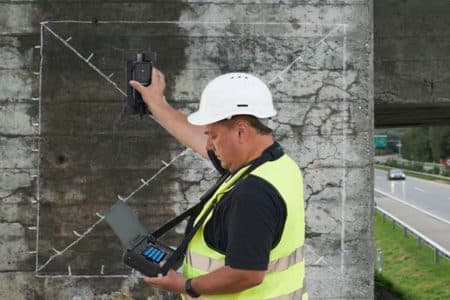
- Scan and mark. The scanner is passed across the member in two directions. Bar positions are marked on the concrete with chalk or marker, and readings are recorded for each location.
- Verify where needed. At agreed locations, a bar may be exposed to confirm its diameter and cover, which calibrates the scan results for that building.
- Report. Results are compiled into marked-up drawings and tables, with comments on any differences from the design.
What you receive
- Bar positions marked on the concrete surface at each scanned location
- Marked-up drawings or sketches showing bar layout, spacing and scan locations
- A cover table listing measured cover for each member, compared with the design value
- Estimated bar diameters, with locations where bars were exposed for confirmation
- Photographs of the test locations
- Engineer's comments on deviations from the drawings and recommended next steps
Rebar scanning compared with other concrete tests
| Test | What it tells you | Damage to concrete |
|---|---|---|
| Rebar scanning | Bar position, spacing, cover, approximate diameter | None |
| Ferro scanning | Image of the bar grid over a marked area | None |
| Rebound hammer test | Surface hardness and uniformity of concrete | None |
| UPV test | Internal quality, cracks and voids | None |
| Core test | Measured compressive strength of the concrete | Small hole, repaired after coring |
What does rebar scanning cost in Bangladesh?
There is no single price, because the work depends on the building and the purpose. The main cost factors are the number of members or the total area to be scanned, the number of floors and locations, access (ladders, scaffolding or occupied areas), whether bars must be exposed to confirm diameter, whether imaging is needed as well as line scanning, and the level of reporting. Combining rebar scanning with other tests in one visit usually reduces the overall cost. Send us your drawings and tell us what you need to know, and we will reply with a written quotation.
Why choose TOTO POWER Engineering?
Our engineers do not only scan; they interpret. Because we also carry out structural assessments and design, we know which members matter, which questions a scan can answer and when a bar must be exposed to be sure. Rebar scanning can be combined with the other tests listed under our testing and inspection services, so one site visit can cover reinforcement, concrete strength and the follow-up recommendations.