
A pile integrity test (PIT) is a low-strain, non-destructive test that checks a concrete pile for cracks, voids or changes in cross-section. A small hammer strikes the pile head and a sensor records the reflected stress wave. TOTO POWER Engineering performs pile integrity tests in Bangladesh before pile caps are cast.
Last updated: 7 October 2026
A pile integrity test (PIT) in Bangladesh is the quickest way to check that newly cast concrete piles are sound before the pile caps go on. TOTO Power Engineering carries out low-strain integrity testing to ASTM D5882 for building, factory and infrastructure foundations. PIT checks the shaft, not the capacity: to confirm bearing capacity, you need a pile load test in Bangladesh.
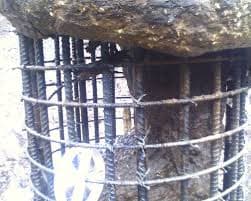
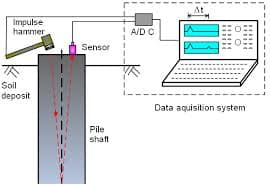
For most concrete and timber piles, the pile integrity test is a non-destructive testing technique. PIT is performed to find major irregularities in the pile shaft, such as cracks, necking, bulging, voids or soil inclusions, and to confirm the pile length. It does not measure the pile's load capacity.
Concrete piles are crucial to a foundation because they transfer loads from large structures, such as bridges, high-rise buildings and factories, to stronger soil layers below. Defects formed during boring and concreting are hidden underground, so an integrity test is carried out to check the piles and prevent potential damage. In this way quality is confirmed before construction of the superstructure begins.
There are generally two methods of low-strain integrity testing:
On site, the test follows these steps:
Problems can be identified with careful analysis of the recorded signals and a sound understanding of the concrete and the soil. A clean signal with a clear toe reflection indicates a continuous pile; an early or strong reflection suggests a change in section or a defect at that depth. Interpretation requires experience, which is why the analysis should be carried out by engineers who regularly work with integrity test data and who know the piling method used on the site.
The two tests answer different questions, and most important foundations need both. If your main question is "how much load can this pile carry?", see our pile load test in Bangladesh page.
| Pile integrity test (PIT) | Pile load test | |
|---|---|---|
| Question answered | Is the pile shaft continuous and free of major defects? | Can the pile carry its design load with acceptable settlement? |
| Strain level | Low strain (light hand-held hammer) | High load applied with jacks and kentledge or reaction piles |
| Typical standard | ASTM D5882 | ASTM D1143 (static axial compressive load) |
| Time per pile | Minutes | Much longer, including set-up and loading stages |
| How many piles | Often a large proportion or all piles | Selected piles only |
| Main limitation | Does not measure capacity | Does not check every pile for defects |
Much of Bangladesh is built on soft alluvial soil, so most multi-storey buildings, factories, warehouses and bridges stand on bored cast-in-place or precast piles. Bored piles are concreted blind, often below groundwater, and problems such as collapsing bore walls, soil falling into the concrete or a break in concreting cannot be seen from the surface. Developers, piling contractors, structural consultants and factory owners use PIT to check every pile quickly while the pile heads are still exposed, so that any defective pile can be dealt with before the pile cap and columns are built on top of it.
ASTM D5882 is the standard test method for low-strain impact integrity testing of deep foundations, covering both the pulse-echo and transient response methods. Pile foundation design and testing requirements in Bangladesh are set by BNBC 2020, together with the project specification prepared by the structural engineer. Where capacity must be confirmed, static load tests are carried out to ASTM D1143.
We quote each project individually. The main cost factors are the number of piles, their diameter and length, how many piles are ready on each visit, the condition of the pile heads, and the site location. Testing in batches reduces the number of mobilisations and so lowers the overall cost. Contact us with your piling layout and programme.
TOTO Power Engineering is an engineering consultancy that has worked across Bangladesh since 2011 and has completed more than 500 projects for industrial, commercial and residential clients. Our engineers combine foundation testing with soil investigation and structural design, so integrity test results are interpreted in the context of the whole foundation, not in isolation. In Bangladesh, the pile integrity test is an essential stage before construction of the superstructure, and we will be glad to help you build a project that is dependable and safe.
A pile integrity test is a low-strain, non-destructive test that checks whether a cast-in-place or precast concrete pile is continuous and of consistent cross-section. A light hand-held hammer strikes the pile head and an accelerometer records the stress wave reflected from changes in the pile and from its toe. The method is described in ASTM D5882.
No. PIT checks the shape and continuity of the pile shaft, not how much load it can carry. To confirm bearing capacity you need a pile load test, usually a static load test to ASTM D1143. Many projects use both: integrity tests on a large number of piles to find defects quickly, and load tests on selected piles to confirm capacity.
Testing is done after the concrete has gained enough strength, as specified by the design engineer, and after the pile head has been cut down to sound concrete, but before the pile cap is cast. Once the cap is in place the pile head can no longer be reached, so it is important to plan PIT into the piling programme early.
The number is set by the structural designer, the project specification or the approving authority. Because PIT is quick and inexpensive per pile, many engineers specify it for a large proportion of piles, or all of them, on important structures. Any pile with a doubtful result can then be investigated further or tested by another method before the cap is cast.
The cost depends on the number of piles, their diameter and length, how many piles are ready for testing on each visit, how well the pile heads have been prepared and the site location. Testing many piles in one mobilisation is usually more economical than repeated small visits. Contact us with your piling layout for a quotation.
The report identifies the depth and nature of the anomaly, such as a reduction in section, a crack or poor concrete at the toe. The structural engineer then decides on the next step, which may be further investigation, coring, a load test on that pile, or a design change such as an additional pile. PIT finds problems while they can still be fixed economically.
