

Soil Test in Bangladesh
A soil test in Bangladesh, also called a sub-soil investigation, drills boreholes on the site, measures soil strength with the Standard Penetration Test, takes samples for laboratory testing and records the groundwater level. The report gives bearing capacity and a foundation recommendation that the structural engineer needs before designing a building.
A soil test in Bangladesh is the first piece of engineering on any new building, and one of the cheapest. Much of the country sits on young river and delta deposits: soft clays, loose silty sands and filled land that can vary within a single plot. The foundation that suits one site can fail on the next, which is why the structural engineer needs measured soil data before designing. TOTO POWER Engineering has worked as an engineering consultancy in Bangladesh since 2011 and carries out sub-soil investigations for residential, commercial and factory buildings from our offices in Dhaka and Chittagong.
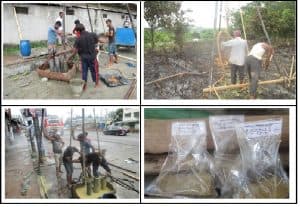
What is a soil test?
A soil test, or sub-soil investigation, is a geotechnical study of the ground beneath a proposed structure. It answers three questions the designer must settle: what layers of soil lie under the site and how thick they are, how strong and compressible each layer is, and where the groundwater sits. From these answers the geotechnical engineer works out the bearing capacity of the ground and the likely settlement, and recommends a foundation type and depth.
A soil test for agriculture, which checks nutrients and pH, is a different service. This page is about soil tests for building and civil engineering.
How is a soil test done?
Boreholes
Most soil tests in Bangladesh use the wash boring method. A casing pipe is driven into the ground and water is circulated to carry cuttings to the surface while the hole is advanced. At regular depth intervals, and wherever the soil changes, drilling stops for testing and sampling. Each borehole is logged as it goes, recording the soil type, colour, consistency and any water strikes.
Standard Penetration Test (SPT)
The Standard Penetration Test, carried out to ASTM D1586, is the main field test. A split spoon sampler is driven into the bottom of the borehole by a standard hammer falling a standard height, and the number of blows needed to drive it a set distance is recorded as the N-value. N-values show how dense a sand or how stiff a clay is, and they are used directly in bearing capacity and pile design.
Disturbed and undisturbed sampling
The split spoon gives a disturbed sample, which keeps the soil's grain size and water content but not its natural structure. In clay layers, thin-walled tubes (often called Shelby tubes) are pushed into the soil to take undisturbed samples that preserve the structure for strength and consolidation tests. Samples are sealed, labelled with borehole number and depth, and transported to the laboratory.
Groundwater level
The water level in each borehole is recorded after it has had time to stabilise. Groundwater affects bearing capacity, the design of basements and excavation, and the choice of construction method.
Which laboratory tests are carried out?
The laboratory programme is chosen to suit the soils found and the building proposed. Common tests include:
- Natural moisture content, which indicates the state of clays and silts.
- Grain size analysis by sieve and hydrometer, which classifies the soil as sand, silt or clay.
- Atterberg limits (liquid and plastic limits), which describe how a clay behaves as its water content changes.
- Specific gravity and unit weight, used in settlement and stress calculations.
- Unconfined compression test, which measures the strength of cohesive soil samples.
- Consolidation test, which measures how much and how quickly a clay layer will compress under the building's weight.
- Direct shear test, which gives the friction angle and cohesion of the soil for bearing capacity and slope or retaining wall design.
How many boreholes does a building need?
The Bangladesh National Building Code (BNBC) 2020 gives guidance on site investigation, including the spacing of boreholes across the footprint and the depth to which they should extend below the expected foundation level. In practice, the number and depth depend on the plot size, the building footprint, the number of storeys and column loads, whether a basement is planned, and how variable the ground turns out to be. A small house on a uniform site needs far fewer and shallower boreholes than a multi-storey factory or a high-rise with piles. Our engineers propose a programme based on your architectural layout and adjust it if the first boreholes show unexpected conditions.
Soil test for building in Bangladesh: what the report contains
A soil test for building in Bangladesh is only as useful as its report. The report we deliver is written for the structural engineer and includes:
- A site plan showing borehole locations and ground levels
- Borelogs for every borehole with soil descriptions, SPT N-values and sample depths
- Groundwater levels
- Laboratory test results with summary tables
- A soil profile interpreting the layers across the site
- Allowable bearing capacity at relevant depths and estimated settlement
- A foundation recommendation, such as isolated or combined footings, a mat, or piles, with the parameters needed for design
- Notes on groundwater, excavation and any special ground conditions
How the soil test process works
- Information. You send the plot plan, the proposed building layout and the number of storeys.
- Programme and quotation. We set the number and depth of boreholes and the laboratory tests, then quote.
- Site work. The drilling team sets out the boreholes, drills, carries out SPT, takes samples and records groundwater.
- Laboratory testing. Samples are tested according to the agreed programme.
- Analysis. Our engineers interpret the results, calculate bearing capacity and settlement, and select a foundation type.
- Report. The signed report is issued, and we answer the structural designer's questions.
What is the soil test cost in Bangladesh?
There is no flat rate for a soil test, because the work is different on every site. The table below shows what drives soil test cost in Bangladesh, so you can compare quotations on the same basis.
| Cost factor | Why it matters |
|---|---|
| Number of boreholes | Set by plot size, footprint and building type; each hole is drilled and logged |
| Depth of boreholes | Taller and heavier buildings, and piled foundations, need deeper holes |
| Laboratory tests | Consolidation and shear tests on undisturbed samples cost more than index tests |
| Site access | Narrow lanes, built-up plots or water-logged land slow down the rig |
| Site services | Wash boring needs water; lack of water or space adds work |
| Location | Mobilising the team and returning samples from distant sites adds cost |
A lower quotation that drills fewer or shallower boreholes may look attractive, but the foundation is a far larger cost than the soil test. Under-investigated sites often end up with an over-designed foundation, or with settlement that is expensive to correct.
Soil test companies in Bangladesh: what to compare
Soil test companies in Bangladesh range from drilling contractors who supply borelogs only to engineering firms that interpret the data and recommend a foundation. Before you choose, check:
- How the company decides the number and depth of boreholes for your building
- Whether SPT is carried out to ASTM D1586 with a calibrated hammer arrangement
- Whether undisturbed samples are taken in clay layers and protected in transit
- Which laboratory tests are included in the price
- Who analyses the results and signs the report, and their qualifications
- Whether the report gives bearing capacity, settlement and a clear foundation recommendation
Choosing soil test companies in Dhaka
Among soil test companies in Dhaka, practical issues matter as much as technical ones. Many plots in the city are narrow, surrounded by existing buildings and served by small lanes, and some are on filled land over former low-lying areas or water bodies, where the upper layers can be loose and variable. Ask how the company will move its rig onto your plot, how it will manage water and spoil, and whether its engineers have experience of filled ground. Developers applying to authorities such as RAJUK should also check that the report format suits their submission.
Why choose TOTO POWER Engineering for your soil test?
We combine soil testing with foundation and building design, so the investigation is planned with the structure in mind. Our structural design and building design teams use the soil report directly, and where piles are recommended we can verify them later with a pile load test. The borelogs are also useful if you plan a deep tube well on the same site. Send us your plot plan and building details to receive a borehole programme and quotation.