

Solar Irrigation Pump System in Bangladesh
A solar irrigation pump system in Bangladesh uses solar panels to power a water pump through a pump controller, lifting groundwater or surface water for crops without diesel or a grid connection. It pumps whenever the sun shines, so it has almost no fuel cost and suits Boro rice, vegetables and other irrigated crops.
TOTO POWER Engineering designs, supplies and installs solar irrigation pump systems in Bangladesh for farmers, agricultural businesses, cooperatives and estates. Irrigation is essential for the Boro season, when rain is scarce and crops depend on groundwater or surface water. Diesel pumps bring fuel costs and supply worries, and grid connections are often unavailable or unreliable in the field. A solar irrigation pump (often called a SIP) uses free sunlight instead, which fits the season well: the dry months that need the most water are also the sunniest.
What is a solar irrigation pump system?
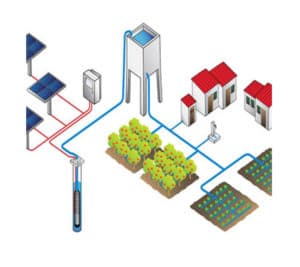
A solar irrigation pump system is a water pumping installation powered by a photovoltaic (PV) array. The panels generate electricity, a pump controller or solar pump inverter converts and regulates that power, and a motor-driven pump lifts water from a tube well, pond, river or canal into the field's distribution channels or pipes. Unlike a diesel pump, it needs no fuel. Unlike a grid pump, it needs no electricity connection, so it can be installed wherever there is sunshine and water.
How does a solar irrigation pump work?
The PV array
The solar modules are mounted on a fixed frame facing south, in an open place with no shade across the panels. Some systems use manual seasonal tilt adjustment or trackers to collect more energy. The array is sized to produce enough power for the pump on an average day in the driest irrigation month.
The pump controller or VFD
The controller is the brain of the system. For AC pumps it is a solar pump inverter, a variable frequency drive (VFD) adapted for solar input, which converts DC power from the panels to AC and varies the motor speed as sunlight changes. It tracks the maximum power point of the array, soft-starts the motor and protects it against dry running, overload and over-voltage. For DC pumps, a DC controller performs the same role.
Surface and submersible pumps
Surface pumps, usually centrifugal pump sets placed on the ground, draw water from ponds, canals, rivers or shallow wells. Floating pump sets are also used on ponds and rivers where the water level changes. Submersible pumps are lowered into a tube well and push water up from deeper aquifers. The choice depends mainly on where the water comes from and how far below ground it lies in the dry season. If you need a new well, see our deep tube well service.
Pipework and storage
Delivery pipes, valves and, where needed, a storage tank or reservoir complete the system. Because most solar pumps run without batteries, storing water rather than electricity is the usual way to irrigate after sunset.
How is a solar irrigation pump sized?
Correct sizing is the most important part of the design. An undersized system cannot keep the crop watered in the hottest weeks; an oversized one wastes money. We size the system from four inputs:
- Daily water need, based on the crop, the irrigated area and the irrigation method. Flooded paddy needs far more water than vegetables under drip or furrow irrigation.
- Total dynamic head, which is the vertical distance from the water level to the discharge point plus the friction losses in the pipes. The dry-season water level, not the monsoon level, sets the design.
- Sunshine hours in the design month, which determine how many hours a day the pump can deliver its flow.
- Water source capacity, so the pump does not draw a well down faster than it recharges.
From these, we select a pump that delivers the required flow at the design head, then size the PV array and controller to drive it.
Solar, diesel and grid irrigation pumps compared
| Factor | Solar pump | Diesel pump | Grid electric pump |
|---|---|---|---|
| Fuel or energy cost | Almost none | High and varies with fuel price | Moderate, billed by the utility |
| Purchase cost | Higher | Lower | Lower, plus connection cost |
| Availability | Daylight hours; less on cloudy days | Any time, if fuel is available | Only when the grid supply is on |
| Maintenance | Low: panel cleaning and periodic checks | High: oil, filters and engine repairs | Low to moderate |
| Location | Anywhere with sun and water | Anywhere fuel can be delivered | Only near a grid line |
| Emissions and noise | None during operation | Exhaust fumes and engine noise | None on site |
Who needs a solar irrigation pump system?
- Farmers and groups of farmers who currently rely on diesel pumps for Boro irrigation
- Irrigation service providers who sell water to neighbouring farmers
- Agricultural estates, nurseries, fish farms and dairy farms
- Fields far from a reliable grid connection
- Rural institutions that also need water for drinking or livestock
How is a solar irrigation pump installed?
- Site visit. We check the water source, water level, field layout, shade and a safe, secure place for the array.
- Water and head assessment. We estimate the daily water need and measure or estimate the total head, including the dry-season water level.
- System design. We select the pump, controller and array, and design the mounting structure, cabling and pipework.
- Supply and foundations. Equipment is delivered, and foundations for the array frame are cast where needed.
- Installation. The array, controller, pump, earthing and delivery pipes are installed. For submersible pumps, the pump and cable are lowered into the well.
- Testing and commissioning. We check array voltage and current, controller settings and protections, then measure flow and head against the design.
- Training and handover. The operator learns daily checks, cleaning and what the controller's fault indications mean.
For conventional grid or generator-driven pumps, or replacement motors, see our pump and motor supply and installation service.
How should a solar irrigation pump be maintained?
A solar pump is easy to operate and maintain, but it is not maintenance-free. Clean the panels regularly, because dust and bird droppings reduce output; in the dry Boro season this may be needed every week or two. Keep grass and crops from shading the array. Check that the frame bolts are tight and the cables are protected from animals and farm machinery. Keep the controller dry, shaded and ventilated. Watch for a drop in flow, which can mean a clogged intake, a worn impeller or a falling water level. Before the monsoon, check the earthing and the drainage around the array foundation.
What you receive
- Site assessment with water source, water level and head data
- Sizing calculation for pump, controller and PV array
- Layout of array, pump, cabling and pipework
- Supplied, installed and commissioned system with flow test results
- Equipment data sheets and warranty documents
- Operator training and a simple maintenance checklist
What does a solar irrigation pump cost in Bangladesh?
The main cost factors are the pump power and type (surface or submersible), the array size, the total head and daily water volume, whether a new tube well or storage tank is needed, the length of pipework, the mounting structure and any security fencing for the panels. Systems built to meet a financing programme's specification may have additional requirements. We visit the site, calculate the size and send a written quotation.
Which standards apply?
The electrical side of the system, including cabling, protection and earthing, follows good practice for low-voltage installations such as IEC 60364, and earthing should be verified by measurement. Where a financing or development programme is involved, it may set its own technical specification for modules, controllers and pumps, and we design to that specification when required.
Why choose TOTO POWER Engineering?
We approach solar irrigation as an engineering problem, not just a product sale: the pump must match the water source, the head and the crop, or the farmer pays for a system that cannot keep up in the driest weeks. Our engineers work across solar, electrical and pump systems, and we have completed more than 500 engineering projects in Bangladesh. We support our customers after installation with technical advice and maintenance. For other solar options, visit our solar systems page or read about solar mini-grids.