

Pile Load Test in Bangladesh
A pile load test in Bangladesh applies a measured load to an installed pile and records how far it settles, to prove the pile can safely carry its design load. The static test uses a hydraulic jack against kentledge or anchor piles; a high-strain dynamic test (PDA) estimates capacity from a hammer blow.
A pile load test in Bangladesh is the most direct way to know whether a deep foundation will do its job. Piles carry the weight of a building down through soft upper soils to firmer strata, and their capacity depends on their size, length, construction quality and the soil around them. Much of Bangladesh is built on soft alluvial clays and loose silty sands, so most multi-storey buildings and factories stand on piles, and the margin for error is small. TOTO POWER Engineering has been an engineering consultancy since 2011 and is enlisted with the Department of Inspection for Factories and Establishments (DIFE). We carry out static and dynamic pile tests for residential, commercial and industrial projects from our Dhaka and Chittagong offices.

Why are piles load tested?
The pile capacity in a foundation design is a calculation. It is based on soil test results and empirical formulae for skin friction and end bearing, and both carry uncertainty. A pile can also fall short because of how it was built: a collapsed borehole, contaminated concrete at the toe, poor cleaning of the base, or a pile that is shorter than designed. A pile load test replaces the estimate with a measurement. It helps to:
- Verify the design capacity of the piles before the pile caps and superstructure are built on them.
- Provide quality assurance on the piling contractor's work, so that poor construction is found while it can still be corrected.
- Show how load is shared between the pile and the soil, and how much the pile settles under working load.
- Optimise the design on large projects, where a test on a preliminary pile can justify a shorter or more economical pile.
Test piles and working piles
A test pile (or preliminary pile) is installed before the main piling work, purely to be tested. It is usually loaded to a multiple of the design load, sometimes until it fails, to find the true ultimate capacity, and it is not used in the finished structure. A working pile (or routine test pile) is one of the building's own piles. It is loaded to a proof load, typically above the working load but well below failure, to confirm it performs as designed without damaging it. The designer specifies which kind of test is needed and to what load.
How is a static pile load test done?
The static load test is the reference method and is carried out in line with ASTM D1143 (axial compressive load) or the specification set by the foundation designer. A maintained load test, which is the most common form, works as follows.
Reaction system: kentledge or anchor piles
The jack needs something to push against. With kentledge, a steel beam assembly over the pile is loaded with concrete blocks, steel or sandbags heavier than the maximum test load. With anchor piles, the reaction beam is tied down to piles installed around the test pile, which work in tension. Kentledge is simple but needs space and a lot of material; anchor piles suit higher test loads and tight sites but must be designed and installed in advance.
Loading and measuring equipment
Load is applied with hydraulic jacks placed between the pile head and the reaction beam. The load is measured with a load cell or a calibrated pressure gauge, and settlement is measured with dial gauges or electronic displacement transducers (LVDTs) mounted on a reference beam supported clear of the test pile and the reaction system, so that the readings are not affected by ground movement around the set-up.
Load increments, holding and unloading
The load is raised in increments, each a fraction of the design load. Each increment is held while settlement readings are taken at set time intervals, until the rate of settlement falls to the value given in the test specification. At the maximum load there is usually a longer holding period. The pile is then unloaded in stages, with readings at each step, to record how much of the settlement is recovered (elastic) and how much is permanent.
The load-settlement curve
All readings are plotted as a load-settlement curve, together with settlement against time for each load stage. The shape of the curve shows how the pile behaves: a gentle, nearly straight curve with good recovery indicates a pile well within its capacity, while a curve that bends sharply or keeps settling under constant load shows the pile is approaching failure.
What is a high-strain dynamic pile test (PDA)?
In a high-strain dynamic load test, carried out in line with ASTM D4945, strain transducers and accelerometers are fixed near the pile head and a heavy drop hammer strikes the pile. A pile driving analyser (PDA) records force and velocity during the blow. The signals are then processed with signal-matching analysis to estimate the mobilised capacity of the pile, how it divides between shaft friction and end bearing, and the stresses in the pile during impact.
The dynamic test is quicker and cheaper than a static test because it needs no kentledge or anchor piles, so several piles can be tested in a day. It is widely used to extend the coverage of a static test programme. It is an indirect method, though: its results depend on good signal quality and on calibration against static tests in similar ground, so the designer decides where it can replace a static test.
Lateral and tension pile load tests
Not every pile is loaded only downwards. Piles under tall buildings, towers, retaining structures and some industrial equipment must also resist lateral loads from wind or earthquake, or tension (uplift). A lateral load test pushes the pile head sideways with a jack reacting against another pile or a block, and measures horizontal deflection. A tension test pulls the pile upwards from a reaction frame bearing on the ground or on adjacent piles. Both follow the same principle of staged loading and careful measurement, and are specified when the design depends on these loads.
How is pile capacity interpreted?
A pile does not pass or fail on a single number chosen on site. The acceptance criteria are set in advance by the foundation designer, in line with BNBC 2020 and the project specification. They usually limit the total settlement at the working load or proof load, the permanent settlement after unloading, and the rate of settlement during the holding periods. Where a test pile is taken to failure, the ultimate capacity is read from the load-settlement curve using a recognised interpretation method chosen by the designer. Our engineers present the measured data clearly and assess it against those criteria; the designer then confirms whether the pile design stands or needs revising.
Pile load test vs pile integrity test (PIT) in Bangladesh
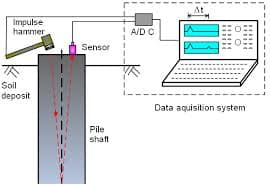
Clients often ask whether they need a load test or a pile integrity test (PIT) in Bangladesh. They answer different questions, and on most piled projects both are used. A pile integrity test is a low-strain test to ASTM D5882: a small hand-held hammer taps the pile head and a sensor records the stress wave reflected from the toe and from any defect along the shaft. Reflections that arrive early or with the opposite sign can indicate cracks, voids, necking or a change in cross-section.
| Aspect | Pile load test (static / dynamic) | Pile integrity test (PIT) |
|---|---|---|
| Question answered | How much load can the pile carry, and how much does it settle? | Is the pile shaft continuous and free of major defects? |
| Standard | ASTM D1143 (static), ASTM D4945 (high-strain dynamic) | ASTM D5882 (low-strain) |
| Load applied | Hydraulic jack against kentledge or anchor piles, or a heavy drop hammer | Light blow from a hand-held hammer |
| Equipment on site | Reaction system, jacks, load cell, gauges or a PDA | Portable sensor and recorder |
| Piles tested | A selected few, as specified by the designer | Many piles, often a large share of the site |
| Main use | Verifying design capacity and settlement | Screening construction quality and choosing piles for further testing |
A common approach is to screen the piles with PIT first, then choose piles for load testing or investigation based on the results. For details of the low-strain method, its limitations and how results are reported, see our dedicated pile integrity test in Bangladesh page.
How do we carry out a pile load test?
- Review of the design. We study the pile layout, pile type, design loads, soil report and the test specification, and agree the test load and acceptance criteria with the designer.
- Test planning. We select the test method and reaction system, prepare the loading schedule and check site access, working space and safety.
- Pile head preparation. The pile head is trimmed, levelled and, where needed, capped so that the load is applied evenly and the head is not damaged.
- Set-up. The kentledge or anchor-pile reaction, jacks, load measurement and settlement gauges on an independent reference beam are installed and checked.
- Loading and monitoring. Load is applied, held and released in the agreed stages, with readings recorded throughout. The client and designer are welcome to witness.
- Dismantling and analysis. The set-up is removed, the data are checked and plotted, and the results are assessed against the criteria.
- Reporting. A test report is issued to the owner and the structural engineer.
What you receive
- Details of the test pile: location, type, size, length and casting date
- Description of the test set-up, reaction system and instruments used
- The loading schedule and the full load, time and settlement readings
- Load-settlement and settlement-time curves
- For dynamic tests, the measured signals and the estimated pile capacity
- Site observations and photographs
- An assessment of the results against the designer's acceptance criteria
What does a pile load test cost in Bangladesh?
There is no single price, because each test is sized to the pile. The main cost factors are:
- Test load. A higher test load needs a heavier kentledge or stronger anchor piles, larger jacks and more handling.
- Number of piles. Testing several piles on one mobilisation is more economical per pile.
- Reaction system. Kentledge must be transported, stacked and removed; anchor piles must be designed and installed.
- Test type. Static, dynamic, lateral and tension tests need different equipment and time on site.
- Site access. Narrow roads, congested urban plots and remote sites affect transport and set-up.
Send us your pile layout, design loads and test specification and we will provide a written quotation.
Why choose TOTO POWER Engineering?
Pile testing is most useful when the people testing understand the design. Our structural design engineers can review the results with you, and our construction supervision team can follow the piling work from installation to pile cap, so problems are dealt with before they are buried. We report what we measure, clearly and without exaggeration, so that the owner and the engineer of record can make a sound decision about the foundation. For other foundation and material tests, see our testing and inspection services.