

Initial Assessment Firm in Bangladesh
An initial assessment firm in Bangladesh inspects a factory or building to find visible structural, electrical and fire safety risks. Engineers review drawings, walk every floor, rank each finding by severity and report whether the building is acceptable, needs a corrective action plan, or needs a Detailed Engineering Assessment (DEA).
Choosing an initial assessment firm in Bangladesh is usually the first step a factory owner takes when a buyer, an inspector or a lender asks whether a building is safe. The initial assessment gives a complete picture of the visible structural, electrical and fire risks in one visit, so you can see where the serious problems are before spending money on repairs or detailed testing. TOTO POWER Engineering is an engineering consultancy operating since 2011 and enlisted with the Department of Inspection for Factories and Establishments (DIFE). Our engineers assess RMG and other industrial buildings, commercial premises and residential blocks across Bangladesh from offices in Dhaka and Chittagong.
What is an initial safety assessment?
An initial assessment, sometimes called a preliminary or visual assessment, is a structured inspection of a building carried out by qualified engineers. It is based on what can be seen and what is recorded in documents, rather than on laboratory testing. The engineers look for conditions that could lead to collapse, electrical fire, electric shock or loss of life in a fire, and they decide how urgent each one is.
The assessment is deliberately broad. It covers the whole building and all three safety disciplines in a short period, which makes it the right tool for screening a building and deciding what to do next. It is not a substitute for a detailed investigation when the structure is in doubt; that is the role of a Detailed Engineering Assessment (DEA).
What does an initial assessment cover?
Structural
The structural engineer compares the building with any approved drawings, then inspects columns, beams, slabs, walls and the roof on every floor. Typical findings include cracks and their pattern, sagging slabs, exposed or corroded reinforcement, honeycombed concrete, unauthorised extensions or extra floors, heavy machinery or stock on floors not designed for it, water tanks added on the roof, and alterations such as removed walls or new openings. Floor loading is observed and compared with the likely design load. Our structural safety assessment page explains the structural side in more depth.
Electrical
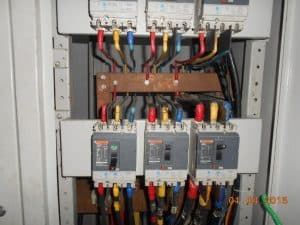
The electrical engineer inspects the substation, generator room, main and sub-distribution boards, cable routes and final circuits. Common findings are overloaded or undersized cables, missing or poor earthing, loose terminations, open panels, unsuitable protective devices, temporary wiring, and signs of overheating. The adequacy of lightning protection and the availability of a single line diagram are also checked. For a deeper electrical review see our electrical safety assessment.
Fire
The fire safety engineer checks the number, width and protection of exits and stairs, travel distances, emergency lighting and signage, fire detection and alarm, extinguishers, hydrants and sprinklers, the separation of boiler rooms, generator rooms and chemical stores, and the fire safety management system including drills and trained staff. Our fire safety assessment service covers fire risks in more detail.
Who needs an initial safety audit firm in Bangladesh?
- Export factories in the garment, textile, leather and other sectors whose buyers require building safety compliance before placing orders.
- Factories preparing for inspection by DIFE, which oversees workplace safety under the Bangladesh Labour Act 2006 and Labour Rules 2015.
- Buyers and tenants of an existing building who want to know its condition before signing.
- Owners planning change, such as extra floors, new machinery or converting a building to a different use.
- Commercial and residential owners who are worried about cracking, old wiring or fire escape routes.
How is an initial assessment carried out?
- Information request. We ask for the building approvals, architectural, structural, electrical and fire drawings, and any earlier assessment reports.
- Opening meeting. On site, we agree access, safety rules and the people who will accompany the engineers.
- Inspection. Structural, electrical and fire engineers walk every floor and the roof, record observations on checklists and photograph each finding with its location.
- Closing meeting. Urgent findings are explained to management before the team leaves, so immediate dangers can be dealt with at once.
- Risk ranking. Each finding is graded by severity and likelihood so that remedial work can be prioritised.
- Report. A written report sets out the findings, photographs, risk levels and recommended actions, including whether a DEA is required.
How are findings ranked?
Ranking matters because a typical factory produces many findings, and not all of them can be fixed at once. We use a simple three-level scale that the owner, the buyer and the engineer can all understand.
| Risk level | Typical examples | Expected response |
|---|---|---|
| High | Serious structural cracking, heavy overloading, locked or blocked exits, exposed live conductors | Immediate action; area may need to be unloaded or evacuated |
| Medium | Missing earthing, inadequate fire detection, unsealed openings in fire separations, minor overloading | Planned correction within an agreed short period |
| Low | Missing signs, untidy cable routes, housekeeping and record-keeping gaps | Correction through routine maintenance and management |
What are the possible outcomes?
An initial assessment leads to one of three outcomes:
- Acceptable. No significant findings; minor items are closed through normal maintenance.
- Corrective action plan. Findings are listed in a corrective action plan (CAP) with responsibilities and deadlines, and closure is verified by follow-up inspection.
- Detailed Engineering Assessment. Where the structure raises real doubt, a DEA with testing and structural analysis is recommended before decisions are made.
What you receive
- An initial assessment report covering structural, electrical and fire safety
- Photographs of each finding with its location in the building
- A risk ranking for every finding
- Recommended corrective actions in a format that can be turned into a CAP
- A clear statement on whether a Detailed Engineering Assessment is needed
- A debrief with management to explain urgent findings
What does an initial assessment cost in Bangladesh?
There is no single price. The main cost factors are the total floor area, the number of buildings and storeys, which disciplines are included (structural only, or structural, electrical and fire together), whether drawings are available or the team must work without them, any buyer-specific reporting format, and the location of the site. We send a written quotation after reviewing basic information about the premises.
Which standards apply?
Structural observations are judged against the Bangladesh National Building Code (BNBC) 2020. Fire findings refer to BNBC 2020, the Fire Prevention and Extinguishing Act 2003 and, where a buyer requires it, NFPA standards such as NFPA 101 for life safety. Electrical findings refer to BNBC 2020 and good practice for low-voltage installations such as IEC 60364. For factories, the Bangladesh Labour Act 2006 and Labour Rules 2015 set the legal framework.
Why choose TOTO POWER Engineering?
We have carried out engineering work in Bangladesh since 2011 and have completed more than 500 projects across our services. Structural, electrical and fire engineers work in one team, so an initial assessment can move straight into a DEA, a CAP, testing or design without a new firm having to learn the building. Every recommendation in the report is tied to a specific finding and photograph, so you can see why each action is needed.