

Core Test in Bangladesh
A core test in Bangladesh measures the actual compressive strength of concrete in an existing building. A cylindrical sample is cut from a column, beam, slab or wall with a diamond core drill, prepared and crushed in a laboratory following ASTM C42, and the corrected result is compared with the strength the structural design assumed.
A core test in Bangladesh is the most direct way to find out how strong the concrete in a finished structure really is. Building owners, factory compliance managers and structural engineers rely on it when drawings are missing, when cube test records are doubtful, when a building is being extended or converted, or when a factory must prove its structural safety to buyers and regulators. TOTO POWER Engineering, enlisted with DIFE and working as an engineering consultancy since 2011, plans, drills, tests and reports concrete cores for residential, commercial and industrial buildings.
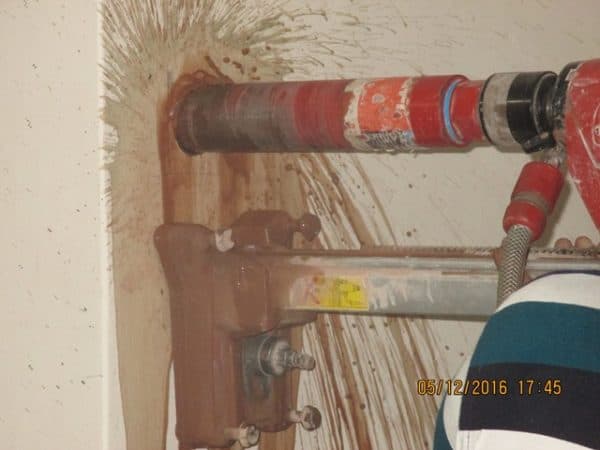
What is a concrete core test?
A core test, sometimes called a semi-destructive test, removes a cylinder of hardened concrete from the structure with a water-cooled diamond core bit. Diamond core drilling cuts cleanly through concrete without hammering, so it does not create the vibration and stress cracks that percussion tools can cause in the surrounding concrete. Wet cutting also keeps dust down; the slurry is collected so that the work area stays clean.
Each core is labelled, described and photographed. The record notes its location, length, the size and distribution of aggregate, voids or honeycombing, and any steel that was cut. The core is then trimmed, its ends are prepared flat and square, and it is crushed in a compression testing machine to give its compressive strength.
When is a core test needed?
- Structural safety assessments of existing factories, where the design strength must be confirmed before loads are checked.
- New construction where cube or cylinder results were low, missing or disputed between owner and contractor.
- Adding floors, installing heavy machinery, or changing a building's use, where the existing frame must carry more load than before.
- Buildings damaged by fire, overloading or long-term corrosion of reinforcement, where the remaining concrete quality is uncertain.
- Buildings with no reliable drawings or construction records, where every structural input has to be measured on site.
In each case the core results are only as useful as the plan behind them. Testing a few convenient members can hide a weak floor or construction phase, so we agree the sampling plan with the structural engineer before drilling starts.
Which standard applies? ASTM C42
The most widely used method in Bangladesh is ASTM C42, the standard test method for obtaining and testing drilled cores of concrete. It covers how cores are drilled, how their dimensions are measured, how they are conditioned before testing, how the ends are prepared, and how the strength is calculated and corrected. The structural assessment then interprets the results in line with BNBC 2020 and the design basis of the building.
Core diameter and length-to-diameter ratio
Core size affects the result. A core must be large enough, compared with the largest aggregate in the mix, to be representative; cores of around 100 mm diameter are common in building assessments, while smaller cores are used only where the member is small or the reinforcement is congested, and their results are treated with more caution. The ideal length is about twice the diameter. Shorter cores tend to give higher apparent strengths, so the standard applies a correction factor to cores with a lower length-to-diameter ratio, and cores that are too short are not tested for strength at all.
Correction factors
Besides the length-to-diameter correction, engineers consider the direction of drilling, the moisture condition of the core at test, the presence of reinforcement in the core, and any damage caused during drilling. Some of these are handled by the test standard and some by the assessing engineer's judgement when converting core strength to an equivalent in-place or design strength. The report states which corrections were applied and why.
How is a core test carried out?
- Review: study the drawings, design strength, previous test records and the purpose of the assessment.
- Plan sampling locations: select members by grade, floor and construction phase, avoiding highly stressed zones such as the ends of beams and the tops of heavily loaded columns where possible.
- Scan for reinforcement first: use rebar scanning to locate bars and mark a clear position, so main reinforcement is not cut.
- Drill: fix the core drill rigidly and cut the core with a water-cooled diamond bit, perpendicular to the surface.
- Label and record: mark each core with its ID and orientation, photograph it and log the location on a plan.
- Repair the hole: clean the hole and fill it with non-shrink grout or suitable repair mortar the same day where possible.
- Laboratory testing: trim, measure, condition and cap or grind the cores, then crush them and record the failure load and fracture pattern.
- Analyse and report: apply corrections, compare results with the design strength and give conclusions and recommendations.
How are core test results interpreted?
Core strength is not compared directly with cube or cylinder strength from the time of construction. Concrete in a structure is cured differently from test specimens, and drilling causes some damage, so in-place strength is normally lower than the strength of standard specimens of the same concrete. Design codes recognise this. A common approach, for example in ACI 318, accepts the concrete of a zone when the average of three cores reaches about 85% of the specified strength and no single core falls far below it. The assessing engineer decides which criterion applies and, if the strength is lower than assumed, re-runs the structural checks with the measured value.
Results that are low or widely scattered call for more investigation, such as additional cores, a wider non-destructive survey, or a review of loads, before any decision on strengthening or load restriction.
Combining core tests with rebound hammer and UPV
Cores are accurate but each one damages the structure and costs time, so engineers combine them with non-destructive methods. A rebound hammer test (ASTM C805) surveys surface hardness at many points, and a UPV test (ASTM C597) checks the uniformity and internal quality of the concrete. The non-destructive results show where the concrete is weakest or most variable; cores are taken there and at typical locations to calibrate the survey.
| Aspect | Core test | Rebound hammer | UPV test |
|---|---|---|---|
| Type | Semi-destructive | Non-destructive | Non-destructive |
| Standard | ASTM C42 | ASTM C805 | ASTM C597 |
| What it measures | Actual compressive strength of a sample | Surface hardness (rebound number) | Pulse velocity through the concrete |
| Strength accuracy | Direct measurement | Estimate; needs calibration | Estimate; mainly shows quality and uniformity |
| Speed and coverage | Slower; few locations | Fast; many locations | Fast; many locations |
| Damage to the structure | Small hole, repaired | None | None |
| Best use | Confirming strength for design checks | Screening and comparing members | Finding voids, cracks and weak zones |
Core tests in a Detail Engineering Assessment (DEA)
For RMG factories and other industrial buildings, core testing is a key input to a Detail Engineering Assessment (DEA). The DEA engineer uses measured concrete strength, together with the as-built dimensions and reinforcement, to check whether columns, beams, slabs and foundations can carry the actual loads safely. Low core results often lead to a corrective action plan with load restrictions or strengthening.
Other tests on concrete cores
- Concrete density
- Carbonation depth
- Chemical analysis, including chloride content
- Water and gas permeability
- Chloride penetration resistance
- Petrographic examination
What you receive
- A core location plan with member IDs and photographs.
- A description and photograph of each core before testing.
- Laboratory results: dimensions, length-to-diameter ratio, load and strength.
- Corrected strengths and a comparison with the design strength.
- Engineering conclusions and recommendations, and a record of hole repairs.
What does a core test cost in Bangladesh?
The cost depends on the number and diameter of cores, the members to be drilled, access and working height, rebar scanning, the laboratory tests needed and hole repair. Tell us the building's size and the purpose of the test and we will send a written quotation.
Why choose TOTO POWER Engineering?
We have completed more than 500 projects since 2011, many of them structural and safety assessments for factories. Our engineers plan core locations with the structural analysis in mind, scan before drilling, repair every hole and explain the results in plain terms. See all our testing and inspection services.