
Ferro scanning uses a Ferroscan device to map the reinforcement bars inside concrete members without demolition. TOTO POWER Engineering uses ferro scanning in Bangladesh to record bar layout, spacing and cover in existing buildings, supporting as-built drawings, structural assessments and safe coring or drilling.
Last updated: 7 October 2026
Ferro scanning in Bangladesh gives engineers a picture of the reinforcement inside concrete without breaking it. Using a Ferroscan-type electromagnetic scanner, our engineers image the bars in slabs, walls, columns and beams to record their position, spacing, concrete cover and approximate size. Unlike ground-penetrating radar (GPR), an electromagnetic scanner can measure cover accurately and estimate bar diameter. Clients use our reports for quality control, building acceptance inspections and structural testing, and to avoid the cost and danger of cutting through structurally critical reinforcement.
We carry out ferro scanning on site and prepare clear reports and drawings from the results. Scan images can be transferred into CAD, so the bar layout can be shown on as-built drawings and used for future design work. When holes must be drilled or cores taken, the scan lets us mark positions that avoid the bars.
Ferro scanning detects steel only. Where you also need to find plastic conduits, voids or other non-metallic objects, GPR is the better tool. Our engineers explain which method suits your question before any work starts, so you pay only for the information you actually need.
The level of detail and the time spent on the scans depend on what you need to know. Scanning in full detail takes longer and produces a large amount of information. For many needs, a simpler approach is just as useful and far more efficient.
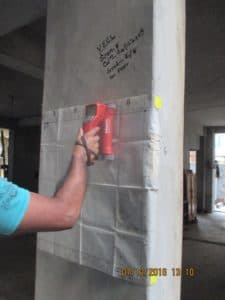
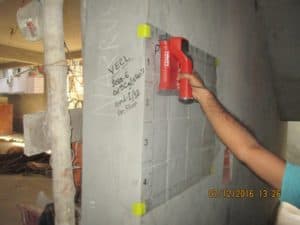
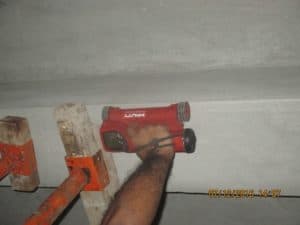
The scanner is passed over the concrete to locate bars, and the operator marks their positions directly on the surface to guide drilling and coring. This is ideal when you simply need to know where it is safe to drill. It needs minimal equipment, is fast to carry out and can be used on most concrete structures.
For a full scan, a grid is marked on the member and the scanner records an image of the whole area. The data is downloaded and analysed to give bar positions, spacing, cover and estimated diameters, which are presented in the report and, where required, on drawings. This approach is used where a member must be examined in detail, for example a critical column in a structural assessment.
Ferro scanning can also be used to check reinforcement and cover in precast concrete units, as part of routine quality control or when a unit's reinforcement must be verified before it is accepted.
Both services use electromagnetic detection, and the terms are often used interchangeably. The difference is in the output. For a fast check of bar positions, spacing and cover across many members, see our rebar scanning in Bangladesh service. Choose ferro scanning when you need a recorded image and measured drawings.
| Ferro scanning (imaging) | General rebar scanning | |
|---|---|---|
| Main output | Image of the bar grid, measured drawings | Bar positions and cover readings, marks on the surface |
| Typical use | As-built drawings, detailed checks of critical members, planning cores and openings | Cover and spacing checks across many members, quick location before drilling |
| Time per member | Longer, as a grid is scanned and analysed | Shorter |
| Detects | Steel reinforcement | Steel reinforcement |
Many older buildings in Bangladesh, including factory buildings that have changed hands or been extended, have no reliable structural drawings. Owners, compliance managers and structural engineers need to know what reinforcement is actually inside the columns and slabs before they can assess the building, add a floor, install heavy machinery or cut new openings. Contractors use ferro scanning before drilling anchors for equipment, racks and services, and quality engineers use it to check new work before acceptance. In each case the scan replaces guesswork with measured information, without damaging the structure.
Required concrete cover and reinforcement detailing for buildings in Bangladesh are set by BNBC 2020 and the structural drawings, and ferro scanning is used to check what has actually been built against them. In structural assessments, scanning is used together with concrete core tests to ASTM C42 and rebound hammer tests to ASTM C805, so that cores are taken between bars and the results can be read together.
Each job is quoted individually. The cost depends on the number of members or scan areas, whether a quick scan-and-mark or a full imaging scan is needed, the finishes and access conditions, whether as-built drawings are required and the site location. Contact us with your scope.
We offer scanning to specifiers, engineers, contractors, demolition companies and building owners. Designers in Bangladesh use ferro scanning for non-invasive concrete investigation and reinforcement mapping on all kinds of buildings. Related tests include the core test and the rebound hammer test, and you can see all our testing and inspection services. Speak with our engineers to plan your survey.
Ferro scanning is a non-destructive method of imaging the steel reinforcement inside concrete with an electromagnetic scanner of the Ferroscan type. The scanner is rolled over a marked area of a slab, wall, column or beam and produces an image of the bar layout, from which bar positions, spacing, concrete cover and an estimate of bar diameter are read. Nothing is broken or drilled.
They use the same principle. Rebar scanning in Bangladesh usually means locating bars quickly to check cover and spacing or to mark them on the surface. Ferro scanning, as we use the term, means recording a full image of an area so the reinforcement can be measured and drawn. Many projects use quick rebar scanning widely and ferro scanning where a detailed record is needed.
Cutting a main bar while drilling anchors or taking a concrete core weakens the member and can make a structural assessment less reliable. A ferro scan shows exactly where the bars are, so core and drilling positions can be marked between them. This is standard practice before core tests, before fixing heavy equipment and before making openings in slabs or walls.
Yes. When original drawings are missing or unreliable, ferro scans of representative columns, beams and slabs show the actual bar arrangement and cover. Our engineers combine these results with dimensions measured on site to prepare as-built reinforcement details, which are then used in structural assessments, detailed engineering assessments and the design of extra floors or retrofits.
Accuracy falls as cover increases and where bars are closely spaced, lapped or in several layers. Bar diameter is an estimate, so it should be confirmed by exposing a bar where the result is critical. The scanner detects magnetic steel only, so plastic conduits and voids are not shown. Scan results are best calibrated with a small number of local openings.
The cost depends on the number of members or scan areas, whether a quick scan-and-mark or a full imaging scan is required, access conditions such as height and finishes, whether as-built drawings are needed and the site location. Combining scanning with core and rebound hammer tests on one visit is usually more economical. Contact us with your scope for a quotation.
