

Deep Tube Well Company in Bangladesh
A deep tube well company in Bangladesh plans, drills and completes wells that draw water from deeper aquifers for factories, buildings and farms. The work covers site selection, drilling, casing and strainer installation, gravel packing, well development, yield and water quality testing, and pump installation, so the well gives a steady supply of usable water.
A reliable deep tube well company in Bangladesh does far more than drill a hole and lower a pipe. Whether the well gives clean water for twenty years or clogs with sand in two depends on where it is drilled, which layer the strainer is placed in, how the gravel pack is built and how carefully the well is developed and tested. TOTO POWER Engineering has worked as an engineering consultancy since 2011 and is enlisted with the Department of Inspection for Factories and Establishments (DIFE). We plan and deliver deep tube wells for factories, commercial and residential buildings and agricultural users, together with the pump and electrical installation that bring the water to the surface.
What is a deep tube well?
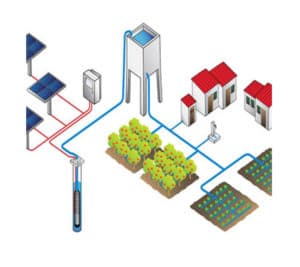
A deep tube well is a narrow, cased well drilled down to a deeper water-bearing layer, or aquifer, below the shallow groundwater. A casing pipe keeps the borehole open, a slotted strainer section lets water in from the aquifer, and a gravel pack around the strainer holds back fine sand. A pump, usually a submersible pump inside the casing, lifts the water to the surface. Deep wells are used where shallow water is insufficient, seasonally unreliable or of poor quality.
Who needs a deep tube well?
- Factories needing a dependable supply of process, cooling or boiler feed water, particularly in industrial areas without a piped supply.
- Apartment and commercial buildings that need their own source alongside or instead of a municipal supply, where permitted.
- Farms and irrigation projects watering fields through the dry season.
- Institutions such as schools, hospitals and housing estates serving many users from one source.
How is a deep tube well built?
Hydro-geological survey and site selection
We start by gathering what is known about the ground and groundwater at your location: existing wells nearby, their depths, yields and water quality, and available hydro-geological information. The well site is chosen for access by the drilling rig, distance from pollution sources such as septic tanks and drains, and a practical route for pipes and power. A digital land survey helps fix the location and levels on larger sites, and an existing soil test report, if you have one, gives useful information on the upper layers.
Drilling
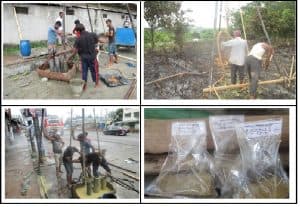
Deep wells in Bangladesh's alluvial ground are commonly drilled by rotary methods, where drilling fluid carries the cuttings out of the borehole. In direct circulation the fluid is pumped down the drill pipe and returns up the borehole; in reverse circulation it flows down the borehole and is drawn up through the drill pipe, which suits larger diameters. The method depends on the depth, diameter and ground conditions. Soil samples are collected at regular depth intervals to build a log of the layers.
Casing and strainer design
Using the drilling log, the engineer selects the aquifer layer and sets the strainer position and length. Casing and strainer material and diameter are chosen for the depth, the pump size and the water chemistry. The strainer slot size is matched to the grain size of the aquifer sand and the gravel pack.
Gravel packing and sealing
Graded gravel is placed in the space between the strainer and the borehole wall to filter out fine sand while letting water flow freely. Above the aquifer, a seal is placed to stop poor-quality water from upper layers or the surface running down the outside of the casing.
Well development
Development removes the drilling fluid and fine particles from around the strainer, for example by surging and pumping, until the water runs clear and sand-free. A well that is not properly developed gives less water, carries sand into the pump and wears out early.
How are yield and water quality tested?
After development, a yield or pump test runs the well at a steady rate while water levels are recorded, then measures recovery once pumping stops. This shows the safe yield and the pumping water level, which are needed to size the pump correctly.
A water sample from the completed well is then tested by a laboratory. In Bangladesh, arsenic and iron are well-known concerns in groundwater, and manganese and salinity can matter in some areas, so the testing parameters are chosen for the intended use and location. If the results show a problem, options include treatment, such as an iron removal plant, or using the water only for purposes where it is acceptable.
Pump installation and power supply
Once the yield and pumping level are known, we select and install the pump. Most deep wells use a submersible pump with a starter panel, protection against dry running and phase failure, and a power cable sized for the depth. See our pump motor supply and installation service for details. For farms and off-grid sites, a solar irrigation pump system can power the well without a grid connection or diesel.
Step-by-step: our deep tube well process
- Requirement and site review. We confirm water demand, intended use and site constraints.
- Permission check. We identify which approvals are needed for your location and help prepare them.
- Well design. We propose depth range, diameter, casing, strainer and gravel pack, subject to the drilling log.
- Drilling and logging. The borehole is drilled and soil samples are logged at regular intervals.
- Completion. Casing, strainer, gravel pack and seal are installed to the final design.
- Development and testing. The well is developed, then yield and water quality are tested.
- Pump installation. The pump, starter, cabling and pipework are installed and commissioned.
- Handover. We hand over records and a maintenance plan.
What you receive
- A well design proposal and final as-built well diagram
- A drilling log showing soil layers and depths
- Casing, strainer and gravel pack details
- Yield test results with recommended pumping rate
- Water quality test results from the completed well
- Pump and starter data and commissioning records
- A maintenance schedule for the well and pump
Which approvals and standards apply?
Groundwater abstraction may need permission from the relevant authority depending on location and use: for example, the water supply authority (such as WASA) in city areas, and local authorities or the Department of Public Health Engineering (DPHE) elsewhere. The requirements vary, so we check them for each site before drilling. Water quality results are compared with the limits that apply to the intended use. Electrical work for the pump follows the electrical part of BNBC 2020 and IEC 60364, and factories remain subject to DIFE inspection of pump rooms and panels.
| Stage | Main risk if done poorly | How we control it |
|---|---|---|
| Site selection | Contamination from nearby sources | Separation from pollution sources, surface seal |
| Strainer placement | Low yield or poor water quality | Decision based on the drilling log |
| Gravel pack and development | Sand in the water, pump wear | Graded gravel, thorough development |
| Pump selection | Overpumping, dry running, motor failure | Sizing from yield test data, protection |
How should a deep tube well be maintained?
Record the static water level, pumping level, output and motor current at regular intervals. A gradual fall in output usually means the strainer or gravel pack is clogging with iron deposits or fine sand. Re-development and cleaning can restore much of the lost yield if done in time. Water quality should be retested periodically, and the pump, cable and starter need routine maintenance of their own.
What does a deep tube well cost in Bangladesh?
The main cost factors are depth, borehole and casing diameter, casing and strainer materials, drilling method, site access, the extent of testing, the pump and electrical works and any water treatment. We assess the site and your water demand, then send a written quotation.
Why choose TOTO POWER Engineering?
We treat a tube well as an engineered system: well design, pump selection and electrical installation are handled together, so the pump suits the well and the motor is properly protected. See all engineering services for related surveys, testing and electrical work.