

UPV Test in Bangladesh (Ultrasonic Pulse Velocity)
A UPV test in Bangladesh measures how fast an ultrasonic pulse travels through concrete, following ASTM C597. Sound, dense concrete carries the pulse quickly; cracks, voids, honeycombing and poor compaction slow it down. The test is non-destructive, so engineers use it to compare concrete quality across a building and decide where cores are needed.
A UPV test in Bangladesh is most often requested when a factory owner, buyer safety programme or building owner needs to know whether the concrete in an existing structure is consistent, and where the weak zones are. TOTO POWER Engineering has been an engineering consultancy since 2011 and is enlisted with the Department of Inspection for Factories and Establishments (DIFE). Our engineers carry out ultrasonic pulse velocity testing as part of a wider set of concrete tests from our Dhaka and Chittagong offices, for RMG factories, commercial buildings and residential structures.
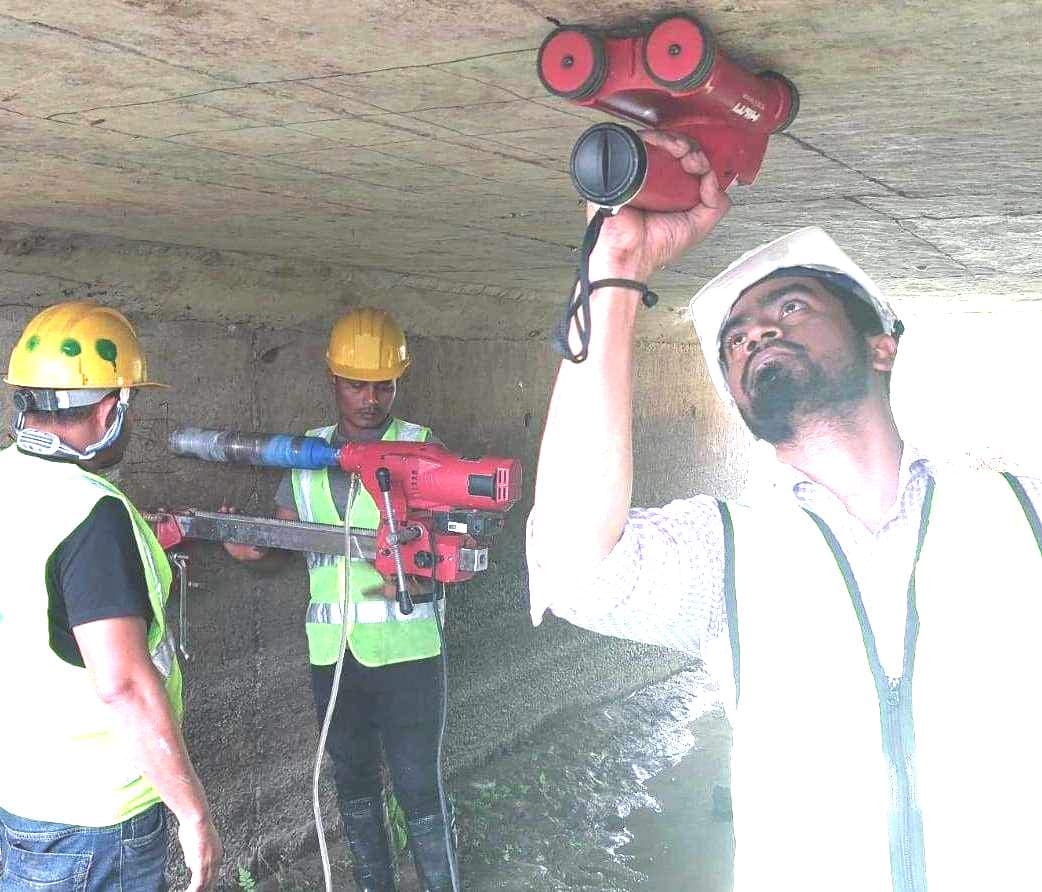
What is a UPV test?
Ultrasonic pulse velocity (UPV) testing sends a short, high-frequency mechanical pulse from a transmitting transducer through the concrete to a receiving transducer. The instrument records the transit time, and the engineer divides the measured path length by that time to obtain the pulse velocity. The method is described in ASTM C597, the standard test method for pulse velocity through concrete.
The principle is simple. A pulse travels fastest through dense, well-compacted, continuous material. When it meets an air-filled crack, a void or a honeycombed zone, it must travel around the defect, so the transit time increases and the apparent velocity falls. Because the velocity also depends on the concrete's elastic modulus and density, readings taken across a building give a picture of how uniform the concrete is.
How do direct, semi-direct and indirect transmission differ?
The arrangement of the transducers controls how reliable the result is. The engineer chooses it according to which faces of a member can be reached.
| Arrangement | Transducer position | Typical use | Reliability |
|---|---|---|---|
| Direct | Opposite faces of the member | Columns, beams, walls with both faces accessible | Highest; preferred method |
| Semi-direct | Adjacent faces, across a corner | Corner columns, members against a wall | Good, if the path length is measured accurately |
| Indirect (surface) | Same face, at increasing spacings | Slabs, retaining walls, crack depth estimation | Lowest; reflects mainly the surface layer |
What can a UPV test reveal?
- Uniformity of concrete. Comparing velocities across many members of the same grade shows which floors, pours or elements differ from the rest.
- Voids and honeycombing. Poorly compacted zones, often near column bases and congested beam-column joints, show markedly lower velocities.
- Cracks. With indirect readings at set spacings either side of a surface crack, the engineer can estimate how deep the crack runs.
- Relative quality. Readings help rank members from better to worse concrete, so that cores are taken from representative and suspect locations.
- Damage from fire or deterioration. Heat-damaged or deteriorated surface concrete transmits the pulse more slowly than the unaffected core of the member.
Some national guidelines publish indicative velocity bands that describe concrete quality in words such as "good" or "doubtful". Where a client asks for them, we quote such bands only as a general guide and state their source, because the relationship between velocity and quality varies with aggregate, mix and moisture. Our conclusions rely on comparison within the building and on calibration with cores.
What are the limitations of the UPV test?
UPV is a valuable screening tool, but it has to be interpreted by an engineer who understands its limits:
- Steel reinforcement carries the pulse faster than concrete, so readings taken along or close to bars can overstate quality. We locate bars first with rebar scanning and place the transducers to avoid them.
- Moisture raises the velocity; wet concrete can appear better than dry concrete of the same strength.
- Aggregate type and mix proportions change the velocity independently of strength.
- Rough surfaces, plaster and poor coupling increase transit time and lower the result.
- Path length must be measured accurately; small errors on short paths produce large errors in velocity.
- UPV alone does not give a compressive strength value.
How is UPV combined with the rebound hammer and cores?
Because each non-destructive method is affected by different factors, engineers often combine them. The rebound hammer test (ASTM C805) reflects the hardness of the surface layer, while UPV reflects the body of the member. Using the two together, an approach widely known as SonReb, reduces some of the uncertainty of either method alone, because factors that raise one reading do not always raise the other in the same way.
Even the combined method needs calibration. The reliable route is to drill a limited number of cores to ASTM C42 at locations selected from the UPV and hammer survey, test them for compressive strength, and build a correlation between the non-destructive readings and the core results for that building. The correlation is then applied to the members that were tested but not cored. Our core test service provides that calibration.
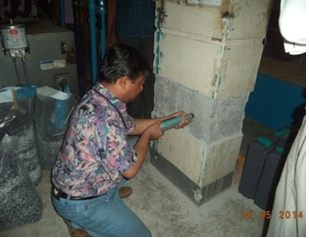
How is a UPV test done?
- Purpose and planning. We review the drawings, the reason for testing and any previous reports, and select members and test points.
- Rebar location. Reinforcement is located by scanning so that pulse paths avoid bars running parallel to them.
- Surface preparation. Plaster and finishes are removed at the test points and the concrete surface is smoothed.
- Calibration check. The instrument is checked against its reference bar before testing.
- Measurement. Transducers are coupled with gel, transit time is recorded at several points per member, and the path length is measured.
- Analysis. Velocities are calculated, compared across members and, where cores are taken, correlated with core strengths.
- Reporting. Results, interpretation and recommendations are issued in a signed report.
What you receive
- A test location plan marked on the floor plans
- Transit time, path length and calculated pulse velocity for each reading
- Transmission method used at each point (direct, semi-direct or indirect)
- Comparison of members and identification of low-velocity zones
- Correlation with rebound hammer and core results, where these are in scope
- Photographs of test points and observed defects
- Engineering conclusions and recommendations for further testing or repair
Where is the UPV test used in Bangladesh?
Detailed engineering assessment of factories
In a detailed engineering assessment (DEA), the engineer must establish the in-place concrete strength used in the structural analysis. UPV and rebound hammer surveys cover many members quickly and identify where cores should be drilled, so the core results represent the whole building rather than a few convenient spots.
Post-fire assessment
After a fire, UPV readings from affected members are compared with readings from unaffected members of the same building. The comparison helps map which columns, beams and slabs have lost quality and how far the damage extends, before repair or demolition decisions are made.
Quality disputes and added floors
UPV also helps when test cylinders from construction are missing or doubtful, when an owner plans to add floors and needs to confirm the existing concrete, and when cracks or honeycombing are found during handover.
Which standards apply?
The test procedure follows ASTM C597. Related methods include ASTM C805 for the rebound hammer and ASTM C42 for drilled cores. The assessment of the structure itself is made against BNBC 2020. Where a buyer safety programme or authority specifies its own testing protocol, we follow that protocol.
What does a UPV test cost in Bangladesh?
There is no fixed price. The cost depends on the number of members and test points, the amount of surface preparation, access and working hours (for example in a running factory), the site location, and whether rebar scanning, rebound hammer and core tests are included. We review your drawings and purpose, then send a written quotation.
Why choose TOTO POWER Engineering?
We test and assess under one roof. The engineers who carry out your UPV test also interpret it together with scanning, hammer and core results, and can take the findings into a structural assessment or retrofit design. That avoids the common problem of a test report full of numbers that nobody has turned into a decision.