

Pump Motor Supply & Installation in Bangladesh
Pump motor supply and installation in Bangladesh covers selecting the right pump for the required flow and head, supplying the pump, motor and starter, and installing them with correct cabling, earthing, alignment and protection. The work ends with commissioning tests that prove the pump delivers its duty point without overloading the motor.
Pump motor supply & installation in Bangladesh is often treated as a simple purchase: buy a pump with the right horsepower and connect it. In practice, a pump that does not match its duty wastes electricity, wears out early, or fails to deliver water when it is needed most. TOTO POWER Engineering has worked as an engineering consultancy since 2011 and is enlisted with the Department of Inspection for Factories and Establishments (DIFE). We select, supply and install pumps and motors for factories, commercial buildings, residential buildings and agricultural users, treating the pump, motor, starter and cabling as one engineered system.
What does pump motor supply and installation involve?
The service covers three linked jobs. First, engineering: working out the required flow, head and operating pattern, then selecting a pump and motor that meet that duty efficiently. Second, supply: providing the pump set, motor, starter or drive, cables, protection and accessories to the agreed specification. Third, installation and commissioning: mounting and aligning the set, connecting pipework and electrical supply, and proving under test that it performs as intended. We select equipment on technical merit for your duty and do not push any particular manufacturer.
Who needs pump installation services?
- Factories needing process water, cooling water, boiler feed or water transfer between tanks.
- Apartment and commercial buildings lifting water from underground reservoirs to roof tanks, or supplying pressure through booster sets.
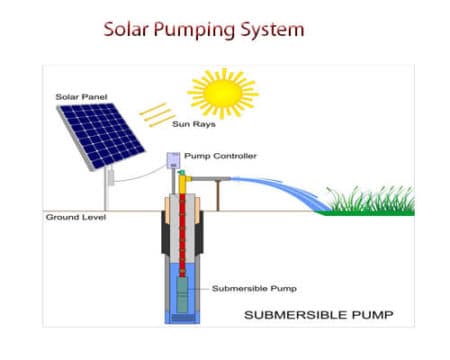
- Owners of tube wells who need a submersible pump matched to the well yield and depth; see our deep tube well service.
- Farmers and agricultural projects irrigating fields, including solar-powered systems.
How is the right pump selected?
Flow, head and duty
Flow is the volume of water needed per hour. Total head is the vertical lift plus friction losses in pipes, bends and valves, plus any pressure needed at the outlet. Together they give the duty point. The pump should run close to its best efficiency point at that duty; an oversized pump throttled by a valve wastes energy, while an undersized one never delivers enough water. We also consider suction conditions, water quality, sand content and how many hours a day the pump will run.
Pump types
| Pump type | Where it is used | Points to check |
|---|---|---|
| Submersible borehole pump | Deep and shallow tube wells | Well diameter, water level, yield, cable size over depth |
| End-suction centrifugal pump | Transfer from reservoir to roof tank, process water | Suction lift, priming, alignment |
| Multistage booster set | Constant-pressure supply in tall buildings | Pressure setting, VFD control, pressure vessel |
| Fire pump set | Hydrant and sprinkler systems | Designed and tested to NFPA 20 |
Fire pumps are not general-purpose pumps. Their sizing, controllers, test arrangements and acceptance testing follow NFPA 20, and they are designed together with the hydrant and sprinkler system. We handle them through our fire hydrant system service.
Which motor starter is right?
The starter affects starting current, mechanical stress, supply capacity and running cost. We select it with the motor rating and the supply in mind:
- Direct-on-line (DOL): simple and robust, suited to smaller motors where the supply can take the starting current.
- Star-delta: reduces starting current for larger surface motors that are wound for it.
- Soft starter: ramps voltage smoothly, reducing current peaks and water hammer in long pipelines.
- Variable frequency drive (VFD): varies speed to match demand, used for booster sets and pumps with changing duty, and often the best choice for energy saving.
Every starter includes overload protection, and we add protection against phase failure, dry running and, where useful, under- and over-voltage, which are common causes of pump motor burn-out on Bangladeshi supplies.
How is a pump motor installed and commissioned?
- Site survey. We record the water source, levels, pipe routes, the available electrical supply and the space for the pump and panel.
- Selection and approval. We calculate the duty, select the pump, motor and starter, and share the data sheets for your approval.
- Supply and inspection. Equipment is checked against the specification on arrival, including motor nameplate data.
- Mechanical installation. Surface pumps are fixed on a level foundation and coupling alignment is checked; submersibles are lowered with the correct rising main, safety rope and cable support.
- Electrical installation. The starter panel, power cable sized for current and voltage drop, earthing and controls such as level switches or pressure sensors are installed and connected; see our electrical installation service.
- Pre-start tests. Insulation resistance of the motor and cable, earthing continuity, rotation direction and protection settings are checked.
- Commissioning. The pump is run and flow, pressure, motor current, voltage, vibration and temperature are recorded against the duty point.
- Handover. We hand over test records and operating instructions and agree a maintenance schedule.
What you receive
- A duty calculation and pump and motor selection
- Data sheets for the pump, motor and starter or VFD
- The supplied and installed pump set with starter panel and cabling
- Pre-start and commissioning test records
- Wiring diagram for the control panel
- Operation and maintenance guidance
Which standards apply?
The electrical side of a pump installation, including cabling, protection and earthing, should follow the electrical part of BNBC 2020 and IEC 60364 for low-voltage installations. Fire pumps follow NFPA 20. In factories, pump rooms and electrical panels fall under the Bangladesh Labour Rules and DIFE inspections. Mechanical installation follows the manufacturer's instructions for foundations, alignment and pipework support.
How should pumps be maintained?
Most pump failures start small: a seal that begins to leak, a bearing that runs hot, a coupling that drifts out of alignment, or a motor whose insulation slowly weakens in a damp pump room. A planned maintenance schedule covers bearings and seals, alignment checks, cleaning of strainers, motor insulation resistance, tightening of terminals and checking starter contacts and protection settings. Tracking motor current and output pressure over time shows wear before it causes a breakdown.
Pumps are often among the largest continuous electrical loads on a site. If your pumping costs seem high, an energy audit can show whether pumps are oversized, throttled or running longer than necessary, and whether a VFD would pay back. For farms and remote sites, a solar irrigation pump system can remove fuel and grid costs altogether.
What does pump motor supply & installation cost in Bangladesh?
There is no single price. The cost depends on the pump type and duty, the motor rating, the starter or VFD, cable size and length, pipework and valves, foundations and civil work, and whether a tube well, tank or control system is included. We survey, calculate the duty and then send a written quotation.
Why choose TOTO POWER Engineering?
We approach pumps as electrical and mechanical engineers, not only as suppliers. That means the pump is matched to its duty, the motor is protected against the supply problems common in Bangladesh, and the installation is tested and documented. See all engineering services for related work such as tube wells, electrical installation and energy audits.