

Third-Party Bill Review in Bangladesh
Third-party bill review in Bangladesh is an independent engineering check of a bill before it is paid. For construction contracts, engineers verify quantities against drawings, the BOQ and the site, and certify the amount due. For electricity, utility and supplier bills, they check tariff category, meter readings, demand and power factor charges, VAT and contract rates.
Third-party bill review in Bangladesh protects owners from paying for work that was not built, energy that was not consumed, or goods and services priced above the agreed rate. TOTO POWER Engineering is an engineering consultancy operating since 2011 and enlisted with the Department of Inspection for Factories and Establishments (DIFE). Our civil, structural and electrical engineers review two kinds of bill for factories, commercial buildings and residential projects: construction and contractor bills, which are checked against the contract and measured on site, and recurring electricity, utility and supplier bills, which are checked against tariffs, meter data and purchase contracts.
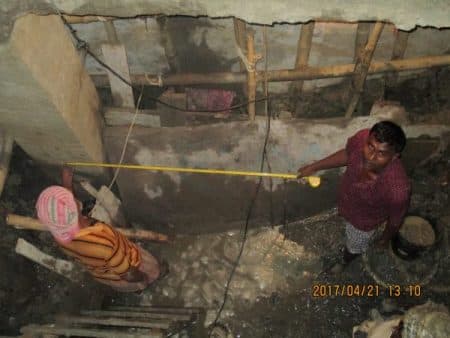
What is a third-party construction bill review?
On most construction contracts in Bangladesh, the contractor submits running (interim) bills as work progresses and a final bill at the end. Each bill claims quantities of work multiplied by rates from the bill of quantities (BOQ), plus any variations, minus deductions such as mobilisation advance recovery, retention, materials supplied by the owner, and taxes. A third-party bill review is an independent engineering check of every part of that claim.
The review is technical rather than purely financial. An accountant can confirm that the arithmetic is right; an engineer can confirm that the volume of concrete claimed for a slab was really poured, that the reinforcement matches the bar bending schedule, and that a claimed variation was in fact extra work rather than part of the original scope. For a wider overview, see our guide to how bill verification works.
Electricity, utility and supplier bill verification
The second part of the service deals with bills that arrive every month rather than once per project. For factories, the electricity bill is often the largest recurring overhead, and small errors repeat month after month until someone checks them. Because our reviewers are electrical engineers, they can read the bill against the connection, the metering and the plant's actual load pattern, not just the arithmetic.
What we check on electricity and utility bills
- Tariff category. Whether the connection is billed under the tariff that matches its voltage level and type of use, as set by the regulator's published tariff.
- Meter readings and multiplying factors. Whether billed units match the meter, whether the CT/PT ratio used in the calculation is correct, and whether any estimated readings were later corrected.
- Demand charges. Whether the sanctioned load and recorded maximum demand used for billing are correct, and whether the sanctioned load still suits the plant.
- Power factor charges. Whether a low power factor penalty has been applied, whether it is justified by the metered data, and whether power factor correction equipment is working.
- Taxes and other charges. VAT, meter rent, late fees and adjustments, and any charges that appear twice across several accounts or meters.
- Gas and water bills. Consumption, tariff and arithmetic checks against meter data and usage records.
Supplier invoices and contracted rates
Invoices from suppliers and service providers are checked against the purchase order or service agreement: unit prices, discounts, quantities delivered, payment terms, taxes and any extra charges that were never agreed. Where a service has ended but billing continues, we flag it. Discrepancies are quantified and documented so that the owner can raise them with the utility or supplier and, where justified, seek a refund or credit for past overpayments. If a bill reveals wasteful consumption rather than a billing error, an energy audit is the logical next step.
Who needs bill assessment in Bangladesh?
- Factory owners building or extending industrial premises, where contracts are large and the owner's team is focused on production.
- Landowners and developers paying contractors in stages for apartment and commercial buildings.
- Banks and financial institutions that release loan instalments against certified progress.
- Organisations and institutions whose boards or auditors require independent evidence before payments are approved.
- Factories and commercial buildings with large electricity bills that want to confirm tariff, demand and power factor charges are correct.
- Owners in a payment dispute who need a neutral, documented measurement of the work actually done.
What do we check in a contractor's construction bill?
Quantities against drawings
Each claimed quantity is recalculated from the approved drawings and compared with the bill. Common problems include double-counting at junctions, using gross instead of net dimensions, and claiming items that are already included in another rate.
Quantities on site
Engineers visit the site to measure completed work and confirm that it exists, is complete and meets the specification. Work that is covered up is verified through measurement books, pour records, photographs and inspection checklists. For large earthwork or land development, quantities can be checked with a digital survey of levels before and after.
Rates and contract terms
Rates are compared with the BOQ, the contract conditions and any agreed price adjustment clauses. We check that the correct item and unit are used, and that new rates for non-BOQ items are justified.
Variations and deductions
Each variation is traced to a written instruction and priced in line with the contract. We also confirm that advances, retention, owner-supplied materials, penalties and statutory deductions have been applied correctly.
Quality of the work billed
Paying for defective work makes it harder to get it corrected. Where our engineers see defects, we recommend that the item be held until it is put right, and we can link the review with QA/QC inspections.

How is a third-party bill review carried out?
The steps below are for construction bills. Utility and supplier reviews follow the same logic: collect the bills, contracts, tariffs and meter records; check every line; quantify each discrepancy with evidence; and report the findings with recommended corrective action and support for any refund claim.
- Document review. We study the contract, BOQ, specifications, approved drawings, variation orders and earlier certified bills.
- Desk check of the bill. Every line is checked for item, unit, rate and arithmetic, and quantities are recalculated from the drawings.
- Site verification. Engineers measure the work on site, sample concealed items through records, and note incomplete or defective work.
- Variation assessment. Claimed variations are checked for authority, scope and price.
- Reconciliation. We prepare a line-by-line comparison of claimed and verified amounts, with a reason for every difference.
- Discussion with the contractor. If the owner wishes, we review the differences with the contractor so that agreed items are settled quickly.
- Certification. We issue a report recommending the amount payable for the interim or final bill.
Interim bills and final bills compared
| Item | Interim (running) bill | Final bill |
|---|---|---|
| Purpose | Payment for work done in a period | Settles the whole contract value |
| Quantities | Cumulative work to date, less earlier bills | Full as-built quantities |
| Variations | Approved variations completed so far | All variations agreed and closed |
| Deductions | Advance recovery and retention for the period | Final reconciliation, retention release terms |
| Main risk | Paying ahead of actual progress | Missing over-measurement accumulated over the project |
What you receive
- A checked copy of the bill with a line-by-line comparison
- Site measurement sheets and photographs
- A schedule of disallowed, reduced or held items with reasons
- An assessment of claimed variations
- A list of defects or incomplete work observed during verification
- A signed certificate or report recommending the amount payable
- For utility and supplier bills: a discrepancy schedule with the financial impact of each error and supporting evidence for discussions or refund claims
Which standards and documents apply?
A bill review is governed first by the contract itself: its conditions, BOQ, specification, drawings and the method of measurement it names. Technical acceptance of work is judged against the specification and the Bangladesh National Building Code (BNBC) 2020. Where the contract does not define a method of measurement, we agree a consistent approach with both parties before measuring.
What does a bill verification audit firm in Bangladesh charge?
Fees depend on the scope rather than a fixed rate. The main factors are the number and value of bills, the type and complexity of work, the number of site visits, the state of the contractor's records and whether the engagement covers a single bill or the whole project. For utility and supplier bills, the main factors are the number of accounts or meters, how many months are reviewed and how complete the records are. We review your contract documents and send a written quotation before starting.
Why choose TOTO POWER Engineering?
Our engineers design, build, test and supervise construction, so they know how work is actually measured and where claims tend to be inflated. Bill review fits naturally with our construction supervision service: the same engineers who inspect the work before each pour can verify the quantities in each bill. We act only for the party that appoints us and keep all contract and pricing information confidential.