

Structural Safety Assessment Firm in Bangladesh
A structural safety assessment firm in Bangladesh checks whether an existing building can safely carry its loads. Engineers inspect the structure, test concrete, reinforcement and soil, analyse the frame against BNBC 2020, and recommend load limits, repairs or strengthening. TOTO POWER Engineering carries out these assessments for factories, commercial and residential buildings.
A structural safety assessment firm in Bangladesh gives building owners an engineer's answer to whether their building is safe to use as it is used today. Many buildings in the country have had floors added, uses changed or machinery installed without a fresh structural check, and some were built without reliable supervision. TOTO POWER Engineering has been an engineering consultancy since 2011, is enlisted with the Department of Inspection for Factories and Establishments (DIFE), and assesses factories, commercial buildings and residential buildings across Bangladesh.
What is a structural safety assessment?
A structural safety assessment, also called a structural audit, is an engineering investigation of an existing building. It establishes what the structure is made of, what condition it is in, what loads it actually carries, and whether it has enough capacity to carry them with an adequate margin of safety. The answer is not a simple pass or fail: the report states which members are adequate, which are not, what loads each floor may carry, and what must be repaired or strengthened.
The assessment matters most for RMG and other factories, where heavy machines, stored fabric and large numbers of workers are concentrated on upper floors. But owners of apartment buildings, shopping centres, schools and offices also commission assessments when they see cracks, plan an extension, or buy an older building.
Who needs a structural audit?
- Export factories whose buyers or DIFE require structural safety evidence
- Owners planning additional storeys, new machinery or a change of use
- Buyers, tenants and lenders checking an existing building before a transaction
- Buildings showing cracks, sagging slabs, settlement or corroded reinforcement
- Buildings without approved structural drawings or with unauthorised alterations
- Buildings affected by fire, flooding or an earthquake
What are the stages of a structural safety assessment?
Structural safety assessment companies in Bangladesh generally follow a staged approach, so the owner only pays for detailed testing when the first stage shows it is needed.
Stage 1: Preliminary assessment for structural safety
The preliminary assessment for structural safety in Bangladesh, often called the initial or visual assessment, is a walk-through by a structural engineer. It records cracks, deflection, spalling and corrosion, compares column and beam sizes with any available drawings, notes floor loads and storage, and identifies unauthorised changes. The result is a categorised list of findings and a recommendation on the next step. Our initial assessment service covers this stage, together with fire and electrical checks if required.
Stage 2: Detail Engineering Assessment (DEA)
If the preliminary stage raises concerns, a Detail Engineering Assessment quantifies the building's real capacity. Engineers prepare as-built drawings, carry out material and soil tests, build an analysis model and check each member against BNBC 2020.
Stage 3: Corrective action and retrofit
Members that fail are addressed through a strengthening or retrofit design and a time-bound Corrective Action Plan (CAP). Interim measures, such as load restrictions or temporary propping, protect occupants until the work is complete and verified.
Which tests are used?
Testing replaces assumptions with measured values. The selection depends on what the preliminary assessment found and what information is missing.
| Test | What it tells the engineer | Method |
|---|---|---|
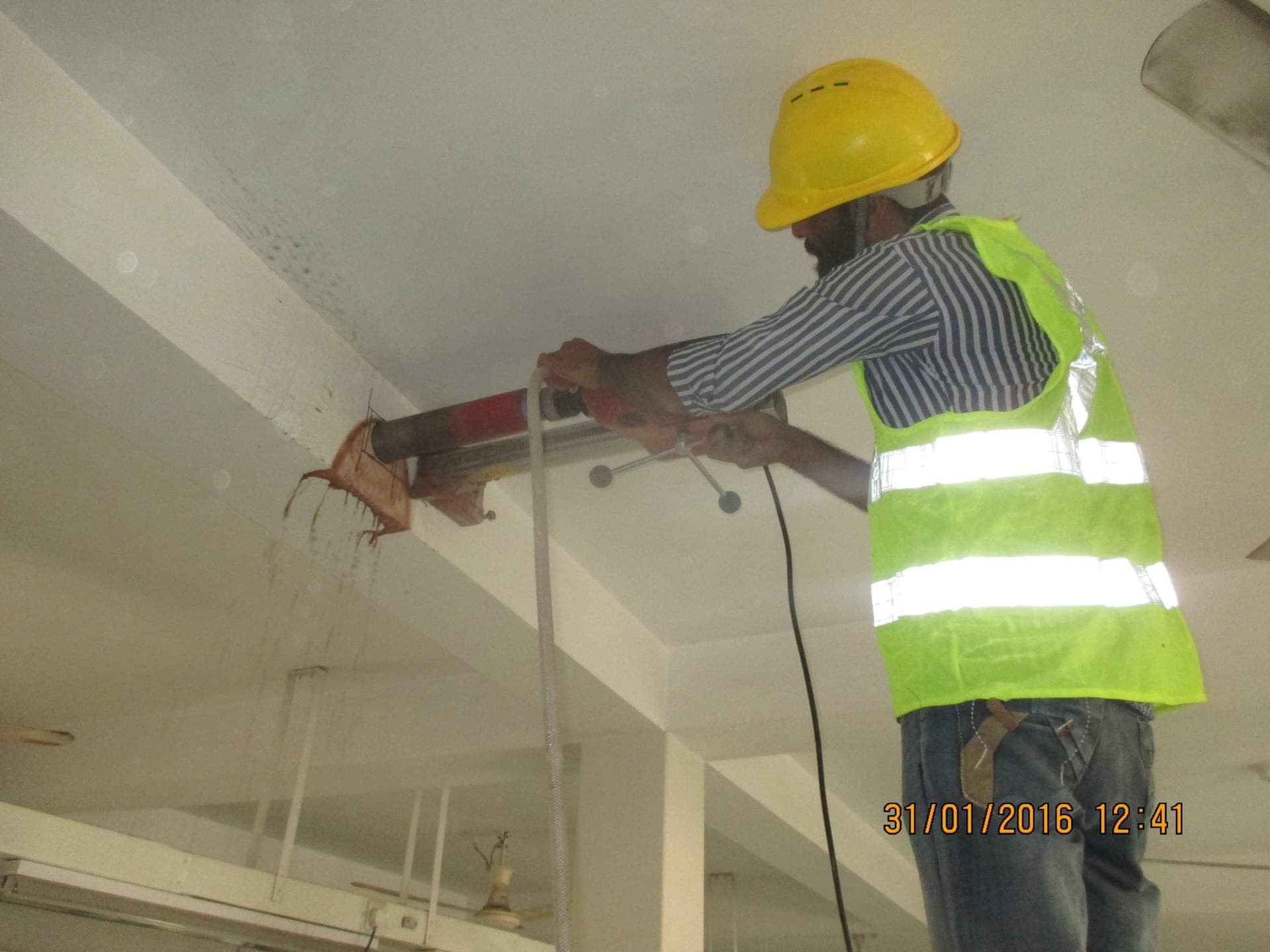
| Concrete core test | In-place compressive strength of concrete | Drilled cores tested in a laboratory (ASTM C42) |
| Rebound hammer test | Surface hardness and uniformity across many members | Non-destructive (ASTM C805) |
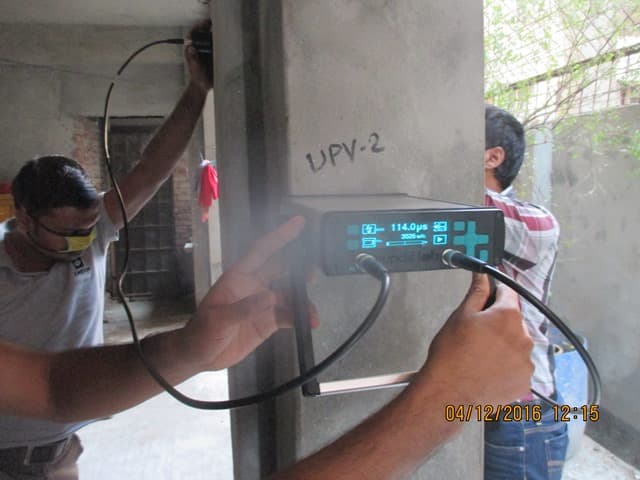
| UPV test | Concrete quality, voids and internal cracking | Non-destructive (ASTM C597) |
| Rebar scanning | Bar position, spacing, cover and approximate diameter | Non-destructive scanning from the surface |
| Soil test | Bearing capacity and soil profile under the foundation | Boreholes and laboratory tests |
How is a structural safety assessment carried out?
- Document collection. We gather approved drawings, earlier reports, soil data and a description of how each floor is used.
- Visual inspection. Engineers inspect every floor, record distress and loads, and decide whether any area needs immediate restriction.
- Dimensional survey. Grid lines, member sizes and floor heights are measured to prepare or verify as-built drawings.
- Testing. Core, NDT and soil tests are carried out at locations chosen to represent each floor and member type, with rebar scanning used first so cores do not cut bars.
- Structural analysis. A computer model of the building is analysed for dead, live, wind and seismic loads using the measured material properties.
- Report and recommendations. Members are checked, safe floor loads are set, and repair or strengthening needs are specified.
- Retrofit design and verification. Where required, we prepare strengthening drawings and verify the completed work on site.
What you receive
- A preliminary assessment report with categorised findings
- As-built structural drawings where reliable drawings do not exist
- Material and soil test results with test locations marked
- Structural analysis summary and member capacity checks
- Floor load plans showing permitted loads for each area
- Retrofit or strengthening recommendations and drawings where needed
- Input to the Corrective Action Plan and close-out verification
Which standards apply?
Structural checks are made against the Bangladesh National Building Code (BNBC) 2020, which sets the loads, including wind and seismic loads, and the design rules for concrete and steel. Material tests follow recognised standards such as ASTM C42 for drilled cores, ASTM C805 for the rebound hammer and ASTM C597 for UPV. For factories, the Bangladesh Labour Act 2006 and Bangladesh Labour Rules 2015 set the employer's duty to provide a safe workplace, with DIFE as the inspecting authority.
What does a structural safety assessment cost in Bangladesh?
There is no single price. The main cost factors are the floor area and number of storeys, the availability of drawings, the number of core and NDT locations, whether soil boreholes are needed, the complexity of the structure and the level of analysis. For a fuller explanation, read our structural safety assessment cost guide. We confirm the scope after a site visit and send a written quotation.
Why choose TOTO POWER Engineering?
We handle every stage in-house: preliminary assessment, testing, analysis, retrofit design and verification, so findings do not get lost between different consultants. With more than 15 years of company experience, DIFE enlistment and engineers in Dhaka and Chittagong, we can respond to RMG factories and other buildings across the country. See our other safety assessment services for fire and electrical audits.