

Safety Assessment Firm in Bangladesh
A safety assessment firm in Bangladesh inspects factories and other buildings for structural, electrical and fire hazards, and reports what must be fixed. Engineers check the building against BNBC 2020, the Bangladesh Labour Act and DIFE requirements, rate each finding by severity, and prepare a corrective action plan the owner can follow.
Choosing a safety assessment firm in Bangladesh is one of the most important decisions a factory owner or compliance manager makes, because the report decides what work is done, how much it costs and whether workers are protected. TOTO POWER Engineering is an engineering consultancy that has been working since 2011 and is enlisted with the Department of Inspection for Factories and Establishments (DIFE). From our Dhaka and Chittagong offices we carry out structural, electrical and fire safety assessments for industrial, commercial and residential buildings, and we stay involved until the corrective work is verified.
Our safety assessment services
Each service below has its own page with the full method, deliverables and FAQs. Most factories need several of them in sequence, so this page explains how they fit together.
- Initial assessment – A visual structural, electrical and fire inspection that identifies hazards and decides whether deeper study is needed.
- Detailed Engineering Assessment (DEA) – An engineering study with drawings, material tests and analysis to confirm a building's capacity and strengthening needs.
- Structural safety assessment – Inspection and testing of columns, beams, slabs and foundations, including load and crack evaluation.
- Electrical safety assessment – Checks of substations, distribution boards, cabling, earthing, protection and thermal hot spots.
- Fire safety assessment – Review of escape routes, fire alarm and detection, fire-fighting systems, separation and fire safety management.
- Energy audit – Measurement of how a facility uses energy and where it can cut consumption and cost.
- Risk assessment – Identification and ranking of workplace hazards with practical controls, following ISO 31000 principles.
- Corrective action plan (CAP) management – Turning audit findings into a tracked plan and verifying that every item is closed.
- BSCI audit support – Preparation for social compliance audits that also look at workplace health and safety.
What does a safety assessment cover?
A building safety assessment looks for conditions that could injure or kill people, especially in a fire, an electrical fault or a structural failure. In Bangladesh the scope normally covers three disciplines, and an assessment is only complete when all three have been examined by engineers qualified in that field.
Structural safety
Engineers inspect columns, beams, slabs, walls and foundations for cracks, deflection, spalling, corrosion and signs of overload. They compare the building with its approved drawings, check whether floors have been added or uses changed, and look at how heavy machinery, stored goods and water tanks are placed. Where the visual evidence raises doubt, a structural safety assessment adds non-destructive and core testing, such as the rebound hammer test and core test.
Electrical safety
The electrical safety assessment covers the substation, transformer, generator, main and sub-distribution boards, cable routing and sizing, earthing and lightning protection, and the protective devices that should disconnect a fault before it starts a fire. Thermal scanning and insulation resistance tests help find hidden overheating and deteriorated cables.
Fire safety
The fire safety assessment checks the number, width and protection of exits and stairs, fire separation, the fire alarm and detection system, sprinklers, hydrants and extinguishers, emergency lighting and signage, and how the factory manages fire risk day to day. Requirements come from BNBC 2020, the Fire Prevention and Extinguishing Act 2003 and, where buyers specify them, NFPA standards.
Why does DIFE enlistment matter?
DIFE is the government authority responsible for safety in factories and establishments under the Bangladesh Labour Act 2006 and the Bangladesh Labour Rules 2015. It maintains a list of firms it accepts for structural, electrical and fire safety assessments. Using an enlisted firm gives the factory a report prepared by engineers whose qualifications DIFE has reviewed, and makes it easier to rely on that report when dealing with inspectors and buyers. TOTO POWER Engineering is enlisted with DIFE. Whichever firm you consider, ask for evidence of its current enlistment and the disciplines it covers.
How do buyer safety programmes affect assessments?
After the building collapses and factory fires of the last decade, international brands sourcing from Bangladesh set up joint safety programmes. The Accord on Fire and Building Safety, later followed by the RMG Sustainability Council (RSC), required supplier factories to complete initial structural, electrical and fire inspections, carry out detailed engineering assessments where needed, and close corrective action plans within agreed deadlines. Many brands continue to ask for evidence of the same steps, either through these programmes or through their own audits. Requirements change over time, so confirm with each buyer which programme and which report format they currently accept.
How does the safety assessment pathway work?
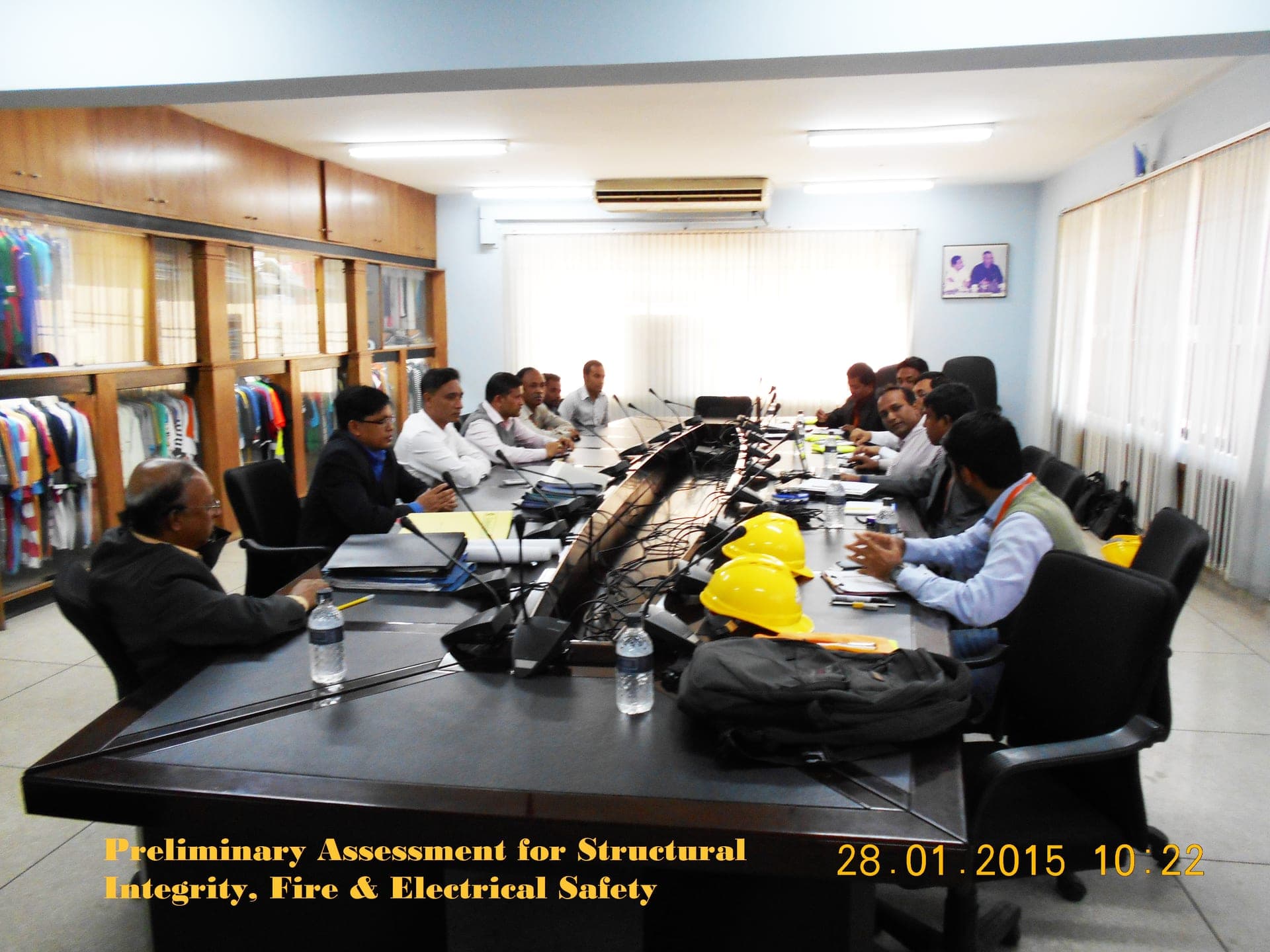
- Initial assessment. A visual initial assessment of structure, electrical systems and fire safety identifies hazards, flags anything that needs immediate action and decides whether a detailed study is required.
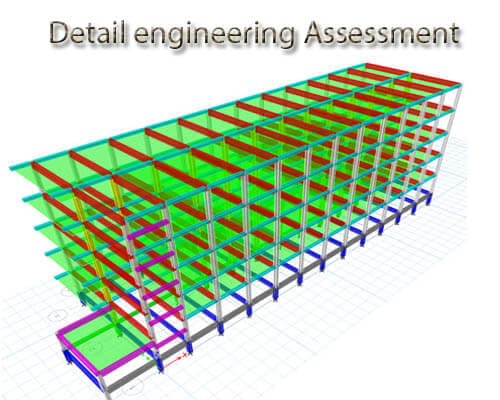
- Detailed Engineering Assessment. Where the structure or a system raises doubt, a Detailed Engineering Assessment (DEA) uses drawings, site measurements, material testing and analysis to confirm capacity and design any strengthening.
- Corrective action plan. Findings are converted into a corrective action plan that lists each item, its priority, the person responsible and a target date.
- Remediation. The factory carries out the work: structural strengthening, electrical upgrades, fire alarm or sprinkler installation, new fire doors and so on. Design support is often needed at this stage.
- Follow-up verification. Engineers return to confirm each item has been completed correctly, record the evidence and update the plan until it is closed.
Which type of assessment do you need?
| Assessment | Purpose | When it is needed | Typical outputs |
|---|---|---|---|
| Initial assessment | Find visible hazards in all three disciplines | First audit, new buyer, change of use or after an incident | Findings list with risk grades and recommendations |
| Detailed Engineering Assessment | Confirm structural capacity with tests and analysis | When the initial assessment raises structural doubt | Test results, analysis, strengthening proposals |
| Structural safety assessment | Evaluate the condition and loading of the structure | Cracks, added floors, heavy machinery or unknown drawings | Condition report, load limits, test data |
| Electrical safety assessment | Find fire and shock risks in the installation | Periodic audit, new loads, overheating or tripping | Findings, thermal images, test records, upgrade list |
| Fire safety assessment | Check means of escape and fire protection | Periodic audit, layout change, new buyer requirement | Findings, escape route review, system upgrade list |
| Risk assessment | Rank workplace hazards and set controls | New process, legal or buyer requirement, incident review | Risk register and control measures |
| Energy audit | Identify energy savings | High bills, expansion or sustainability reporting | Energy balance and savings measures |
What you receive
- A written assessment report for each discipline, with photographs
- Each finding graded by risk, with a recommended corrective action
- Immediate-action notices for anything that endangers people now
- Test results and thermal images where testing was carried out
- A draft corrective action plan with priorities
- Follow-up verification records as items are closed
How to choose a safety audit firm in Bangladesh
People often search for the "best safety assessment firm in Bangladesh", but the right firm is the one whose engineers and process suit your building. Use this checklist when comparing any safety audit firm in Bangladesh:
- Is the firm currently enlisted with DIFE, and for which disciplines?
- Will qualified structural, electrical and fire engineers attend site, or only general inspectors?
- Can the firm carry out its own non-destructive testing, thermal scanning and electrical tests, or will it subcontract them?
- Does the report grade risks clearly and give practical recommendations a contractor can price?
- Can the firm support remediation with structural design, electrical and fire design, and then verify the work?
- Will the firm show you a sample report and explain its follow-up process?
- Does it have offices or engineers close enough to visit promptly when needed?
A risk assessment or an energy audit firm can be added to the same visit, and factories preparing for social compliance reviews can combine the assessment with BSCI audit preparation.
Which standards apply?
Safety assessments in Bangladesh draw on BNBC 2020 for structure, fire and building services; the Bangladesh Labour Act 2006 and Labour Rules 2015 for workplace safety; the Fire Prevention and Extinguishing Act 2003; IEC 60364 for low-voltage installations; IEC 62305 for lightning protection; and NFPA 72, NFPA 13 and NFPA 101 where buyers or designs call for them. The report states which standard each finding is assessed against.
What does a safety assessment cost in Bangladesh?
There is no single price. The cost depends on the floor area and number of buildings, the disciplines included, whether approved drawings are available, how many tests are needed (core tests and structural analysis add the most), the reporting format a buyer requires, and how many follow-up visits the corrective action plan will need. We visit or review your building information first, then send a written quotation that lists exactly what is included.
Why choose TOTO POWER Engineering?
We are a DIFE-enlisted firm that has completed more than 500 projects, and we combine assessment, testing, design and verification in one team. That means the engineers who find a problem can also design the fix and confirm it has been done properly. To start, tell us about your building and which buyer or authority the assessment is for, and we will recommend the right starting point on the pathway above.